Summary of the UK 2021 food report

FSA has released their annual food standards report reviewing food industry trends and changes after the pandemic and the Brexit, here are the impacts on your business:
Since the beginning of COVID-19, in conjunction with the departure from the EU, the UK’s food system was greatly affected in many aspects, including food and feed safety, restaurant compliance and imported food monitoring.
Every country possesses it’s own food safety standards, and has potential food dangers when imported or exported. The summary of the Food Standards Agency (FSA) Report 2021 contains:
The Nation’s Plate
Data shows that over the past ten years, the nation’s nutrient intake stayed consistent, but although the sugar intake decreased overall, consumers eat more than the recommended dosage with about 28% of England adults living with obesity as of 2019. The average weight of adult-age Brits increased with the lack of physical activity and the change in the way adults ate throughout the pandemic – showing an overindulgence in sugar-filled and fatty foods and not enough portions of fibers, fruits, vegetables and fish. But who is responsible for this?
Average consumption of free sugars as a proportion of daily total energy (2020)
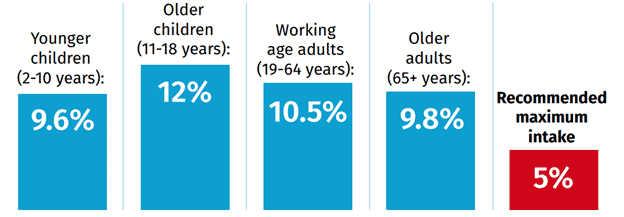
Source: Public Health England NDNS: Diet and physical activity – a follow-up study during COVID-19
Average daily saturated fat consumption as a proportion of daily total energy (2020)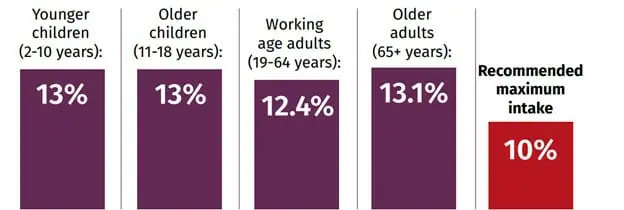
Source: Public Health England NDNS: Diet and physical activity – a follow-up study during COVID-19
According to research from the FSA and FSS’s (The UK Public’s Interests, Needs and Concerns Around Food research), 22% of people in the UK order from takeout and 23% order delivery services at least once a week – mostly coming from young adults or those from higher income households.
The factors found to influence our food choices in recent years according to this data include:
- The price of food: Healthy foods are “priced out” for most people and difficult to keep both wallet and body healthy
- Health concerns: After education over the years, 49% of people interviewed alerted to avoid food with trans fats, palm oil, preservatives, or E numbers
- Eating trends: More people are turning to a “flexitarian” diet to reduce their meat intake
- Ethical concerns: the treatment of animals in the food chain would be a factor of not eating meats; the plastic waste would be another key factor in environmental concern
Impacts from the pandemic on food consumption choices:
- Having healthy eating is tougher to the consumers due to their financial situations
- The pandemic allows more people to cook at home and have healthier options
- Consumers tended to eat more snacks during the lockdown
- More online grocery shopping
Public priorities for the future (research from The FSA and FSS’s The UK Public’s Interests, Needs and Concerns Around Food research) include:
Priority 1: Ensure equitable access to healthy, safe, and affordable foods
- More people intend to purchase healthier foods with an affordable price
Priority 2: Maintain & strengthen food safety and hygiene standards:
- 43% of consumers enforce clearer labelling of food ingredients and allergens is the key priority
Priority 3: Act on additives and processed foods
- People are aware that unhealthy foods contain trans fats, palm oil, preservatives, or E numbers
(Download the full report from the FSA for more priorities, or request demo here for enhancing your business)
Going global:
% of total UK imports sourced from the EU and from other regions, 2017-21
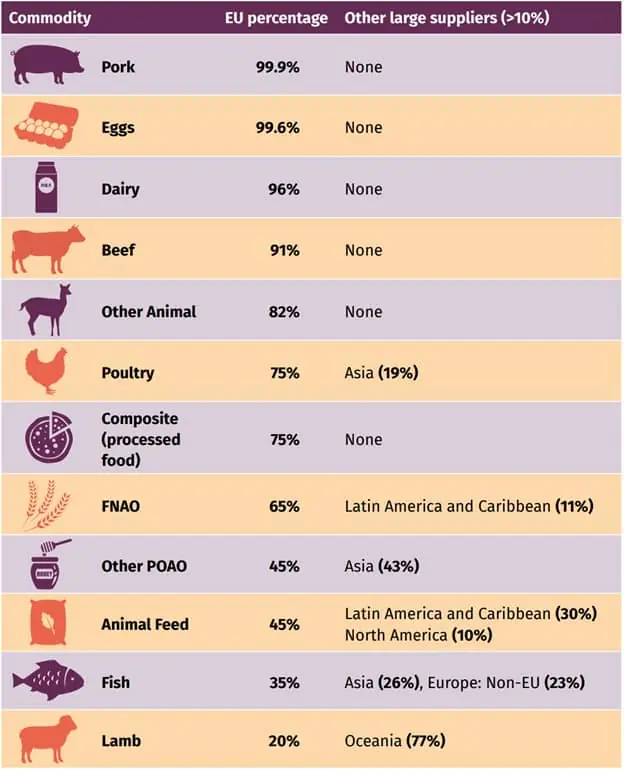
- Around 40 million tons of food are imported from abroad every year; the EU remains by far the biggest supplier, accounting for over 90% of all beef, dairy, eggs, and pork products imported into the UK and nearly two-thirds (65%) of all food and feed not of animal origin
- Despite recent volatility in import patterns, there are no signs of any immediate or wholesale shift in trading flows following the UK’s departure from the EU, though EU imports of fish, lamb and mutton, and pork have all fallen between 2019 and 2021.
- Although there is no evidence that the standards of EU imports have fallen, the FSA and FSS believe the current situation does reduce our ability to prevent foods that do not meet the UK’s high standards from being placed on our market. The lack of import controls means we are not receiving official assurance from the exporting country that imports meet the UK’s high food and feed safety standards; the absence of border checks could also affect how we identify and respond to safety risks in future, with additional resource required by the UK to maintain levels of food safety assurance for these imports
The impact of EU departure on import controls:
- The protocols on Ireland/Northern Ireland took effect on 1 January 2021 and requires Northern Ireland to apply EU import requirements on any products entering the EU regulatory zone from outside the EU
- Not receiving official assurance from the exporting countries that those imports meet the UK’s high food and feed safety standards
To keep rapid alerts available from the latest news from the world, Safefood 360° RISK provides alert system to monitor. Safefood 360° RISK combines both RASFF and World Bank data for the most up to date news and risk alerts and monitor safety alerts worldwide.
Safe and Sound:
- There are 2,363 reported food incidents in the UK in 2021, down from 2019 (2,598) but remains similar number to 2020 (2,261).
- Contamination by harmful micro-organisms was the most frequently reported hazard: 584 cases (browse our technical datasheet to understand how to prevent the harm from the hazards)
- There have been increasing numbers in incidents involving poultry meat in the UK from 2019 – 2021 (83 to 238 cases); especially seen in Salmonella in breaded chicken (download our datasheet about the Salmonella to know the prevention of it)
- Dietetic food incidents have nearly doubled since the previous year (128 cases to 207)
Total number of product recall information notices issued in the UK
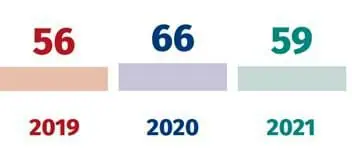
Source: FSA/FSS Incident Management Systems
There are 59 cases of recall in the UK in 2021.
Once the food incident has been identified, the food product may have to be withdrawn or recalled, not only costing food businesses money and reputation, but also directly affects the public’s health.
Most of the incidents can be avoided by the good management procedure (HACCP) and by managing the food process with Safety plan management solution. Request a demo to learn more about how Safefood 360° helps you to reduce the chances of food related incidents.
Informing Consumers
The UK’s departure from the EU prompted a series of actions designed to minimise disruption, including new legislation, changes to compositional standards and origin labelling. A new UK Nutrition and Health Claims Committee (UKNHCC) has also been established to provide expert advice and scrutiny on food marketing claims. Existing arrangements remain in Northern Ireland under the terms of the Protocol on Ireland/Northern Ireland.
The food labelling must contain the information below:
- Name and description
- Ingredients list
- Nutritional information
- Best before or use by date
- Warnings if the food contains additives such as caffeine
- Places of Origin
Food Labels

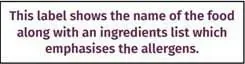
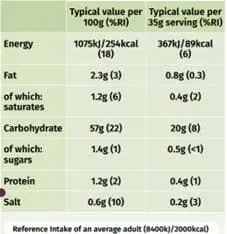
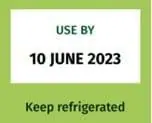
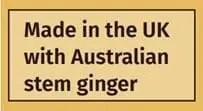
Source: Our Food 2021, FSA report
From a consumer’s point of view, this has had very little noticeable impact to date – the immediate focus has been on maintaining continuity with existing EU laws to minimise any disruption to the supply chain. However, for food business owners, some important foundations for a post-EU approach to food information standards have been put in place:
- Food law changes into British law
- Removing mutual recognition of food composition standards from 1 Oct 2022
- Changes to address and country of origin labelling
What if you have over 500 products in your food business? Our Food Safety Management Solution is designed to improve your business processes within the food industry, allowing you to easily pass audits and maintain compliance with GFSI recognised food safety standards. Browse our Food Safety Management Solution to learn how it helps your business and your supplier chain.
If you are ready to learn more now, request a demo with one of our food safety experts.
Keeping It Clean
The current level of legal compliance with hygiene standards across food and feed businesses in the UK:
Keeping to monitor the latest legilastion is not easy. Safefood 360° provides an integrated platform for your food safety management and supplier quality management. The software is built by a group of food experts to customise what you really need to secure the assurance and make your aduit become easy. If you have any questions about your current FSMS, SQMS or RISK Assessment systems, submit a demo request for a professional consultation to get your business into next level.


Da Vinci Foods achieves SQF Certification
in blogBig congratulations to our valued customer, Da Vinci Foods, which successfully achieved certification to the SQF Code Version 7, Level 3 with only two minors recorded! The result represents a tremendous achievement for the guys at Da Vinci Foods. We are delighted at the role played by our software solution in achieving this result.
It will come as no surprise to anyone responsible for food safety that the certification audit represents one of the most stressful events in the calendar year and even with significant effort and attention the outcome can be uncertain. This is due to the changing landscape of food safety management within a food processing plant. The days of minimum regulatory compliance have long passed to be replaced by a more complex compliance framework including legal, regulatory, commercial and global standards. The food safety system must now meet the needs of various and sometimes disparate stakeholders. For example Da Vinci Foods (like many food plants in Australia) need to meet the needs of Coles Stores, IGA (Independent Grocers of Australia), Food Standards Code Australia & NZ (FSANZ), SQF and Food Act Vic 1984. While they all require a food business to have in place a food safety system they can vary in their focus, purpose and methodology. Da Vinci Foods also set for itself internal objectives regarding the amount of paperwork, access to information, ensuring currency of documents, control of monitoring activities and reporting.
We can see that the modern food safety management system is more than simply a system of generating and collecting records. It is now a core management process required to support internal management functions, support strategic business objectives, meet regulatory requirements and demonstrate a company’s commitment to its customers.
Today, a food safety system is complex in nature – which is not necessarily a bad thing. It is when our efforts to meet these requirements result in a system which is complicated that our difficulties emerge. Our brains can easily cope with complex systems once they are structured and logical. When poorly designed and complicated they become impossible to manage and non-conformances become inherent in their operation. It was with this insight that Da Vinci Foods selected Safefood 360 as their platform to implement, record and manage their food safety system. Working with the guys we were able to put in place a robust and sophisticated system capable of addressing both their internal and external needs without the intrinsically complicated solution typical with traditional manual paper systems. In the process we were able to streamline the system making it easy to maintain – a core requirement for Da Vinci Foods management. The solution also provided constant monitoring in real time and allowed more time for management to manage their business.
For me it was a pleasure to work with the guys at Da Vinci Foods; provide them with a product that meets industry requirements, is easy to use and leaves them with a tool to continually improve their system. In short we were able to work together to make something that is normally complicated – robust and simple to use.
Leonardo Da Vinci, the great renaissance artist and inventor once said;
When it came to designing Safefood 360 we had this as a guiding principle. Simple, intuitive but ultimately a sophisticated tool for meeting the often complex needs of a food safety system.
Once again congrats to the guys at Da Vinci Foods – well done! We look forward to our continued partnership and to introducing you to our exciting new product developments in the coming months.
Where’s the beef?
in blogIn the last four weeks Europe has witnessed the most significant crises to hit the beef sector since BSE in the late eighties and early ninety’s. Once again, consumer confidence has been shattered in the wake of the horse meat controversy calling into question the quality, safety and provenance of the food we eat. Since the news hit the headlines key questions still remain unanswered as the food sector and regulatory authorities struggle to gain control and clear the confusion. These questions are fundamental to the legality and safety of food in the global supply chain.
Risk Communication
The controversy first emerged following DNA testing conducted by the Food Safety Authority of Ireland (www.fsai.ie) on beef burgers which found the presence of horse DNA in a number of samples. Investigations quickly focused on processing plants in Ireland including a major beef processor where one burger sample contained 29.1 per cent horse DNA. At this stage retailers and regulatory agencies were busy communicating the message to the general public that while unacceptable there was no food safety risk – comforting news for many. But for those of us old enough to remember the days of BSE we recalled a sharp lesson concerning food safety issues – beware the risk of risk communication. In 1990 the UK government and Minister John Gummer undertook a campaign to tell the public there was no risk to human health from beef. Eventually in 1996, the UK government admitted there was a link between BSE and the human form of the disease, new variant CJD. While very different in nature, the two events share a common theme regarding the communication of risk. Communicate only what is factually known and be clear to the public on the gaps in the current body of knowledge. Otherwise trust between shareholders and the public is eroded. In recent weeks as the ‘no food safety risk’ message was being communicated, events overtook that message.
Late last week the Food Standards Agency (FSA) in the United Kingdom announced that meat in beef lasagne products recalled by Findus contained 100% horsemeat. Findus said it did not believe it was a food safety issue. The chief executive of the Food Safety Authority of Ireland said that until test results for the equine veterinary medicine phenylbutazone were known, the potential health risk to the public remained unclear. Consumption of horse meat is in itself not a food safety risk but this is not necessarily the point. Whether or not a food safety issue actually exists (and of course we look forward to confirmation of this) the damage has already been done. Confusion, conflicting messages, delays in getting the facts; all contribute to a general feeling of malaise and cynicism among consumers. The message of ‘safety’ was communicated before proper risk assessment had been completed, before an investigation of exposure was undertaken and before hazard analysis was completed. Where was the coordinated response by the Commission and its member states? Where are the principles of risk analysis required under food safety regulations arising from the BSE and dioxin issues of the 1990’s? Consumers don’t always want the best news story. Often they crave the real story based on the available information at that time and this must include uncertainty! The public may wish that the authorities and food sector have all the answers available immediately. Failing this they want to trust those leading the management of the issue. As it stands now, we appear to have neither.
Traceability – where’s the beef?
One of the key remaining questions is how did horse meat enter the food chain and find its way into products labelled as beef? To answer this question we must first answer where did it come from? Four weeks on we still do not have the answer. Irish authorities stated that the source was Polish. The chief veterinary officer in Poland claimed that his country was not the source of the contamination. Attention has now turned to Romania as the source of the horse meat in the Findus recall. This has led to an angry reaction from Romanian politicians.
EU Regulation No 178/2002 – general principles and requirements of food law sets out specific requirements on traceability. According to the European Commission’s Health and Consumer Protections Directorate General Factsheet ‘Traceability is a risk-management tool which allows food business operators or authorities to withdraw or recall products which have been identified as unsafe. It is a cornerstone of the EU’s food safety policy.’ The same fact sheet goes on to painfully state ‘traceability allows targeted withdrawals and the provision of accurate information to the public, thereby minimising disruption to trade.’ For food businesses the legal framework requires them to be able to identify where their products have come from and where they are going and to rapidly provide this information to the competent authorities. I am not suggesting that anyone in this controversy has failed to meet these obligations. What I am saying is that four weeks on we appear to be struggling to determine the exact source(s) of the horse meat. Is it unreasonable to expect that after four weeks this information would be available? If not legally, does the spirit of regulation 178 not suggest that four weeks is excessive? Given the disruption to the trade, the loss of business and jobs already in this controversy many might feel that the collection of data has not been timely and the principles of traceability have failed.
Third Party Certification and Retailer Inspections
A number of the food plants at the centre of the controversy were certified under global food safety standards and were subject to technical audits from large retailers and food service brands. From the non-expert perspective it is legitimate to ask how this issue could arise under this level of third party verification. For me the question is not that simple. Those of us in the area know that auditing programs are often sampling exercises and testing programs while audited are not usually defined by auditors in terms of their scope. Nonetheless the horse meat issue and similar controversies have the potential to damage the credibility of schemes under the GFSI and third party certification at a time when they are gaining significant momentum globally. It is essential that the benefits of certification are not lost in consumer indifference.
Recent Events
It is understandable that those responsible for the management of this issue should be anxious to get out the message that there is no food safety risk. After all this is the most important issue – protection of public health. However it is just as important that the consuming public have confidence in those businesses and authorities responsible for the legality and safety of the food supply chain. The on-going horse meat issue follows on from the Germany bean-sprout / E.coli outbreak. Alarmingly both can be characterised by the confusion for the public, poor risk communication, blame directed towards other member states and erosion of public confidence.
For me they both raise a more fundamental issue – that of the role of the European Commission. The BSE and dioxin issue resulted in many lessons for the food industry and a root and branch redrafting of food safety legislation. Few would dismiss the advances made from the resultant legal framework. However events have highlighted weaknesses such as the lack of a single enforcement agency not bound by national considerations.
It also raises the question of traceability as a risk management tool. In both cases the intent of Regulation 178 had not happened in practice or at least in a timely fashion. There is also evidence that individual member states may not always be best placed to deal with issues with a pan-European character. The emerging blame culture by one member state against another is unseemly and not I believe in the interests of a common food market or the consumer.
Perhaps it is time for the Commission, member states, food businesses, retailers and certification schemes to review the excellent progress made in food safety management arising from BSE and other global food safety issues. Perhaps this should be followed up with clear identification of the lessons to be learnt from more recent events. Perhaps this could lead to positive changes in the legal and commercial framework and how we manage these issues. I believe the consuming public would not judge them too harshly and recognise that with the passage of time every system of control needs improvement and development. In the spirit of the GFSI perhaps it is time for a Management Review meeting.
About the author
George Howlett is the CEO of Safefood 360° and one of Europe’s leading food safety experts. Before establishing Safefood 360° he worked at some of Ireland’s most prominent companies and brings the expertise with him. George also lectures in the MSc for Food Safety Management in the Dublin Institute of Technology.
Management Commitment & the Food Safety Manager
in blogIn a recent thread on the IFSQN forum a brave member posted her disappointment at having failed their initial SQF certification audit. The post highlighted for me the often hidden reality for many food safety professionals, quality managers and food technologists who are responsible for the implementation and maintenance of food safety systems. Systems which are the first and last line of defence for ensuring the protection of public health, valuable retailer brands and the viability of the food companies. The post also highlighted the human aspect of food safety management where senior level management is not sufficient to achieve certification. It is a valuable lesson. Even where a competent food safety manager is put in place, without senior management commitment, this person’s dedication is not enough. I suppose it is not by accident that Management Commitment as a requirement is found on page one, chapter one of almost every food safety standard.
For the local quality manager who attempts to bridge this gap in management commitment the impacts can be both personally and professionally devastating. This is something many of us know all too well and can defy all our definitions of reasonable logic. Why should the owners and managers of a food company not take food safety seriously? Why should they not invest in their business to ensure best practice is implemented and maintained? Surely it is in their interests to do so leaving them free to get on with the business of making money without worrying about food safety issues? Are we missing something here that explains this apparent lack of business logic? These are important questions for the food industry and over the years I have developed my own perspective and for me two issues are central to understanding this situation.
Management Commitment
As already mentioned, almost all food safety standards open with the requirement for management commitment. Some even try to define what this looks like. In truth it can be a very subjective thing for an auditor to tick this box. There are certain objective items of evidence which can be relied upon to help determine the level of management commitment including the existence of a policy, defined improvement objectives, management reviews and the application of human and financial resources. However it is possible for these requirements to be met while management commitment is lacking. The application of sufficient human and financial resources can depend on who you ask. What is sufficient for one person may be insufficient for another. The auditor ultimately has to depend on other data and a more holistic assessment of the food safety systems.
It is also possible for senior management to be fully committed but simply not know what is required to obtain and maintain full compliance. They are normally not food technologists with no training or in depth understanding of food safety or legislation. They are aware requirements exist but no more than that. In short senior management simply may not get it! This can led to major difficulties in the business with middle management struggling to gain the necessary support to implement the required systems. There is little doubt that poor management commitment results in internal difficulties, poor audit outcomes and compliance failures. But this is not the full story. There is I believe a more fundamental question related we need to consider – the Food Safety Manager.
The Food Safety Manager
It is now typical to find a Food Safety Manager in almost all food companies. They go by a wide range of titles including Quality Manager, Food Technologist, Hygiene Manager and Technical Manager to name a few. They are usually graduates from various food science and technology courses and are fundamentally scientists in training, education and nature. After leaving college they take up these positions in industry and find themselves responsible for the Food Safety Management system. They quickly realise the four years spent studying covered little if any content on Food Safety Management. What has any of this got to do with Management Commitment you may ask? Well, surprisingly a lot. Let me explain.
As a young graduate I took up a position as a laboratory technician in a dairy processing plant. I was a junior member of the laboratory team. We occupied our time testing milk, cream and cheese for various bugs and product constitutions. Nice work for an inexperienced food technologist just out of college and back in the days when food safety control was exercised through analysis after the product was made. Then one day the senior technical manager appeared in the laboratory and announced we needed to implement something called HACCP.
‘What is HACCP?’ we asked. ‘I don’t know’, he replied, ‘but we need to put it in place. Anyone want to volunteer?’ More through my youthful naivety than any superior knowledge on the subject I was given the job. I guessed it had to beat butterfat and somatic cell count analysis eight hours a day… It turned out to be a great experience but one not without its difficulties. The reason was that senior management simply did not get it. This was a great company which never refused to invest in quality and food safety but it was in the early days of HACCP and so the level of consciousness was low. I was also a junior member of the team and lacked the skills required to educate senior members. The job got done but it took time.
In later years I went into business as a consultant and again quickly found that many of my clients while wanting to obtain certification and customer listings, either lacked the desire or knowledge to put in the required work. I had the option of putting it all down to a lack of management commitment and in some cases this was true. However as a consultant depending on the daily charge out fee to earn my living I needed to effect change in these companies one way or another. Otherwise it was back to the day job. I came to understand that my role was not simply to put in place HACCP but also to educate, develop awareness, persuade and cajole senior management to support and commit to the requirements. This is the core issue. Food Safety Management is exactly that – Management. The question arises is a lack of management commitment always the cause or is lack of management skills among our food safety managers the issue?
During my time as a Quality Manager in a large multinational food company, I had the opportunity to sit at management meetings and observe the behaviour of my fellow managers. These included the Operations Manager, Financial Controller, Human Resources Manager, Purchasing Manager and Sales Director. Over time I began to see one interesting fact. These were Managers, while I was a Technologist! They never took for granted that resources would be provided to them simply because they wanted them. They had to argue and convince the senior management first. More interestingly, they were completely fine with this. They saw it as their job. Some battles they won and some they lost. The key difference was they were trained managers where I was not. I understood that if I was to achieve my objectives as a food safety manager I would need to become a manager first and a technologist second. Ask any consultant what they see as their most important skill and they will not tell you the seven principles of HACCP. They will tell you it is their ability to communicate, challenge, develop and change the culture of senior management. This allows them to get the job done, earn a living and provide the client with a valuable service and usually in spite of the managements’ conscious wishes.
Food Safety Management – A profession in waiting
If we are to call our profession a profession we must also seek and demand that we produce graduates who possess all the skills necessary to manage food safety and that includes the ability to bring along those senior managers who do not get it.
In my other work as a lecturer on food safety management I see every year graduates who lack the basic management skills required. Communication skills, financial skills, negotiation skills, project management, human resources management – all these are as important as HACCP if not more so. They drive our effectiveness as a manager. It is not the technologists fault. They are very good, competent and committed professionals in their own right but we put them into positions without the necessary skills and this needs to change. At undergraduate level we need to equip our future food safety managers with the skills of a manager!
Poor management commitment exists but a more prevalent problem is poor management consciousness. The most effective tool to address this is the development of our profession to produce not just technologists but competent managers who can deliver this knowledge in the context of a commercial business with finite resources. Our colleges need to produce Food Safety Managers in the truest sense of the word. The industry needs it, senior management need it and more importantly the dedicated and often overwhelmed food safety manager needs it. This is the support and commitment they need most.