Summary of the UK 2021 food report

FSA has released their annual food standards report reviewing food industry trends and changes after the pandemic and the Brexit, here are the impacts on your business:
Since the beginning of COVID-19, in conjunction with the departure from the EU, the UK’s food system was greatly affected in many aspects, including food and feed safety, restaurant compliance and imported food monitoring.
Every country possesses it’s own food safety standards, and has potential food dangers when imported or exported. The summary of the Food Standards Agency (FSA) Report 2021 contains:
The Nation’s Plate
Data shows that over the past ten years, the nation’s nutrient intake stayed consistent, but although the sugar intake decreased overall, consumers eat more than the recommended dosage with about 28% of England adults living with obesity as of 2019. The average weight of adult-age Brits increased with the lack of physical activity and the change in the way adults ate throughout the pandemic – showing an overindulgence in sugar-filled and fatty foods and not enough portions of fibers, fruits, vegetables and fish. But who is responsible for this?
Average consumption of free sugars as a proportion of daily total energy (2020)
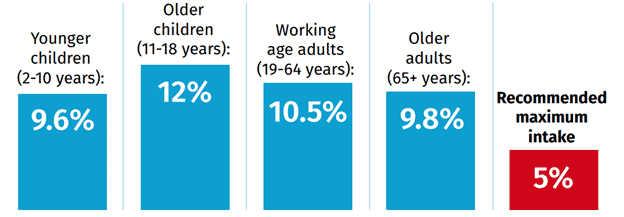
Source: Public Health England NDNS: Diet and physical activity – a follow-up study during COVID-19
Average daily saturated fat consumption as a proportion of daily total energy (2020)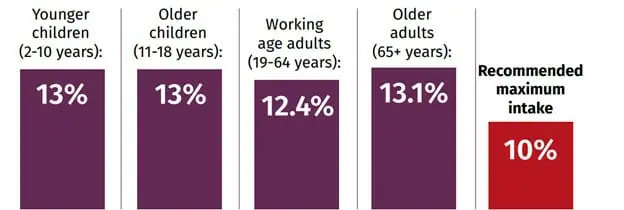
Source: Public Health England NDNS: Diet and physical activity – a follow-up study during COVID-19
According to research from the FSA and FSS’s (The UK Public’s Interests, Needs and Concerns Around Food research), 22% of people in the UK order from takeout and 23% order delivery services at least once a week – mostly coming from young adults or those from higher income households.
The factors found to influence our food choices in recent years according to this data include:
- The price of food: Healthy foods are “priced out” for most people and difficult to keep both wallet and body healthy
- Health concerns: After education over the years, 49% of people interviewed alerted to avoid food with trans fats, palm oil, preservatives, or E numbers
- Eating trends: More people are turning to a “flexitarian” diet to reduce their meat intake
- Ethical concerns: the treatment of animals in the food chain would be a factor of not eating meats; the plastic waste would be another key factor in environmental concern
Impacts from the pandemic on food consumption choices:
- Having healthy eating is tougher to the consumers due to their financial situations
- The pandemic allows more people to cook at home and have healthier options
- Consumers tended to eat more snacks during the lockdown
- More online grocery shopping
Public priorities for the future (research from The FSA and FSS’s The UK Public’s Interests, Needs and Concerns Around Food research) include:
Priority 1: Ensure equitable access to healthy, safe, and affordable foods
- More people intend to purchase healthier foods with an affordable price
Priority 2: Maintain & strengthen food safety and hygiene standards:
- 43% of consumers enforce clearer labelling of food ingredients and allergens is the key priority
Priority 3: Act on additives and processed foods
- People are aware that unhealthy foods contain trans fats, palm oil, preservatives, or E numbers
(Download the full report from the FSA for more priorities, or request demo here for enhancing your business)
Going global:
% of total UK imports sourced from the EU and from other regions, 2017-21
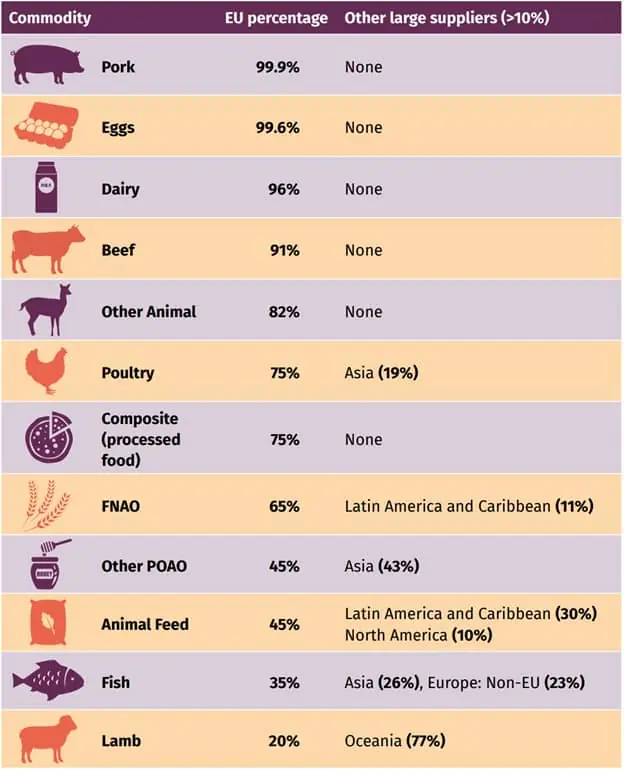
- Around 40 million tons of food are imported from abroad every year; the EU remains by far the biggest supplier, accounting for over 90% of all beef, dairy, eggs, and pork products imported into the UK and nearly two-thirds (65%) of all food and feed not of animal origin
- Despite recent volatility in import patterns, there are no signs of any immediate or wholesale shift in trading flows following the UK’s departure from the EU, though EU imports of fish, lamb and mutton, and pork have all fallen between 2019 and 2021.
- Although there is no evidence that the standards of EU imports have fallen, the FSA and FSS believe the current situation does reduce our ability to prevent foods that do not meet the UK’s high standards from being placed on our market. The lack of import controls means we are not receiving official assurance from the exporting country that imports meet the UK’s high food and feed safety standards; the absence of border checks could also affect how we identify and respond to safety risks in future, with additional resource required by the UK to maintain levels of food safety assurance for these imports
The impact of EU departure on import controls:
- The protocols on Ireland/Northern Ireland took effect on 1 January 2021 and requires Northern Ireland to apply EU import requirements on any products entering the EU regulatory zone from outside the EU
- Not receiving official assurance from the exporting countries that those imports meet the UK’s high food and feed safety standards
To keep rapid alerts available from the latest news from the world, Safefood 360° RISK provides alert system to monitor. Safefood 360° RISK combines both RASFF and World Bank data for the most up to date news and risk alerts and monitor safety alerts worldwide.
Safe and Sound:
- There are 2,363 reported food incidents in the UK in 2021, down from 2019 (2,598) but remains similar number to 2020 (2,261).
- Contamination by harmful micro-organisms was the most frequently reported hazard: 584 cases (browse our technical datasheet to understand how to prevent the harm from the hazards)
- There have been increasing numbers in incidents involving poultry meat in the UK from 2019 – 2021 (83 to 238 cases); especially seen in Salmonella in breaded chicken (download our datasheet about the Salmonella to know the prevention of it)
- Dietetic food incidents have nearly doubled since the previous year (128 cases to 207)
Total number of product recall information notices issued in the UK
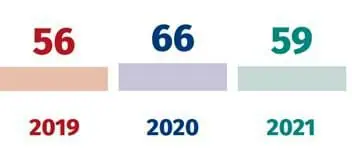
Source: FSA/FSS Incident Management Systems
There are 59 cases of recall in the UK in 2021.
Once the food incident has been identified, the food product may have to be withdrawn or recalled, not only costing food businesses money and reputation, but also directly affects the public’s health.
Most of the incidents can be avoided by the good management procedure (HACCP) and by managing the food process with Safety plan management solution. Request a demo to learn more about how Safefood 360° helps you to reduce the chances of food related incidents.
Informing Consumers
The UK’s departure from the EU prompted a series of actions designed to minimise disruption, including new legislation, changes to compositional standards and origin labelling. A new UK Nutrition and Health Claims Committee (UKNHCC) has also been established to provide expert advice and scrutiny on food marketing claims. Existing arrangements remain in Northern Ireland under the terms of the Protocol on Ireland/Northern Ireland.
The food labelling must contain the information below:
- Name and description
- Ingredients list
- Nutritional information
- Best before or use by date
- Warnings if the food contains additives such as caffeine
- Places of Origin
Food Labels

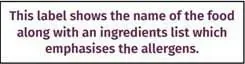
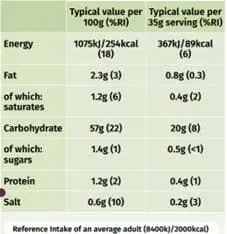
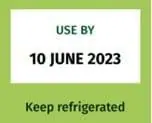
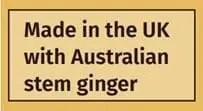
Source: Our Food 2021, FSA report
From a consumer’s point of view, this has had very little noticeable impact to date – the immediate focus has been on maintaining continuity with existing EU laws to minimise any disruption to the supply chain. However, for food business owners, some important foundations for a post-EU approach to food information standards have been put in place:
- Food law changes into British law
- Removing mutual recognition of food composition standards from 1 Oct 2022
- Changes to address and country of origin labelling
What if you have over 500 products in your food business? Our Food Safety Management Solution is designed to improve your business processes within the food industry, allowing you to easily pass audits and maintain compliance with GFSI recognised food safety standards. Browse our Food Safety Management Solution to learn how it helps your business and your supplier chain.
If you are ready to learn more now, request a demo with one of our food safety experts.
Keeping It Clean
The current level of legal compliance with hygiene standards across food and feed businesses in the UK:
Keeping to monitor the latest legilastion is not easy. Safefood 360° provides an integrated platform for your food safety management and supplier quality management. The software is built by a group of food experts to customise what you really need to secure the assurance and make your aduit become easy. If you have any questions about your current FSMS, SQMS or RISK Assessment systems, submit a demo request for a professional consultation to get your business into next level.


Introducing Live Updates..
in Product Updates‘Knowledge is Power’. As a scientist, Francis Bacon knew what he was talking about when he coined this phrase. With knowledge comes the power to make decisions and act in the most appropriate way to achieve our objectives. However we also know that a little knowledge can be dangerous while too much can be overwhelming. When we need to obtain knowledge, we also need to ensure it is of good quality, timely and pertinent.
The world of food safety management is dynamic. This is true whether we are talking about food safety at a global level or at the local plant site. Notifications, recalls, withdrawals, alerts, emerging hazards and scientific developments are all fixed features of the food safety landscape. These events occur daily and impact on the management of food safety. Or let me put it more accurately – these events should impact on our management of food safety but in many cases don’t. The reasons why this is the case are varied but one which many of us will recognise as significant is the difficulty of identifying the sources of information and the time required to review them. To find the time in the working day to stay on top of this constant stream of events is difficult. When things become busy for the food safety manager certain things are dropped from the to-do-list and updates are usually the reluctant victim.
This however is a luxury no longer available to the food safety manager. The GFSI has now made the need to stay up to date on what is happing in the world of food safety a requirement. It is now audited and regardless of the pressures felt by managers most will agree that this should be the case. If there is a recall of an ingredient which you might use in your products this is something you want to know as soon as possible. If there is a new emerging hazard that needs to be addressed in your HACCP plan it is better to know before a product recall brings it to your attention.
In my own time as a manager I tried my best. I was a prolific subscriber to every update email service from the relevant regulatory agencies. Every day my inbox would be bulging with notifications screaming for my attention until eventually the ‘move to trash’ function relieved my pain. I knew a service or a facility which filtered the noise and made the pertinent updates available to me in the place and time that I worked would be more than powerful – it would be an essential tool.
This week Safefood 360 launched its Update service for our customers and we are excited! It represents the first of a series of new functions and features that brings our food safety platform closer to the real world where the effectiveness of local food safety management is expressed – the food market. Customers can now view on their Dashboard live updates of real time events across the globe. These are fed to your dashboard as you work hour by hour on your own food safety system. It will provide updates on the following:
We have provided customers with the ability to select which sources they wish to receive updates from including the FDA, USDA, EU and local national regulatory agencies.
We are also proud to continue our association with the International Food Safety and Quality Network (IFSQN) which is the largest global online community of food safety specialists. Topics and posts from the community are fed live to the Updates page linking our users with their peers from around the world.
Finally, users have the option of viewing the source update to ensure they are receiving accurate information. Where the update is relevant and requires further assessment by the company the user can click on the review button and generate their review record within Safefood 360.
Auditors and customers will no doubt have a smile on their face when learning of this new feature. We are sure you will find it invaluable.
Microsoft Meltdown – Outage Post Mortem
in blogOn Friday, February 22 at 12:44 PM PST the Safefood 360 application became inaccessible to our customers for several hours. Three days earlier we experienced a briefer outage lasting over an hour. For this we are really sorry.
Our software is hosted on the Microsoft Windows Azure Platform which is a global network of state of the art, highly resilient data centers. This platform provides us with the security, stability and performance we need and has done so flawlessly for two years up to this point.
This first outage occurred on Tuesday when Microsoft were conducting some upgrade work to the SQL Server database system in their East Coast United States data center. There was an unexpected malfunction in the work being carried out and as a result all databases in that data center became unavailable. We were immediately notified and our failover plan kicked in which involved;
Within 90 minutes the database system was restored to full operation and all traffic was redirected back to our primary application. Such isolated incidents like this are extremely rare but can still happen from time to time and we are satisfied that our failover plan is sufficient to provide a satisfactory workaround for such unlikely occurrences.
What happened yesterday however was completely unprecedented and unrelated to the earlier issue. This outage was caused by an expired security certificate in Microsoft’s storage service. Any application, including ours, which relies on accessing this storage layer over HTTPS was immediately brought down as communication could not take place over a secure channel. This same security certificate was used in all data centers across the network and therefore our failover plan could not be triggered. This resulted in our application and our customer’s data becoming inaccessible for several hours – something which was never supposed to happen. Every enterprise software application globally which relies on the Azure Platform was in the same boat.
One of the key reasons why Microsoft globally distributes their data centers is to provide for redundancy in the event of a failure in any single data center. What happened yesterday was said to be impossible, and therefore is an event we had not planned for. Yet it happened and did so because of the simplest little oversight of a Microsoft employee.
Naturally this has prompted the Safefood 360 technical team to completely rethink our disaster recovery strategy. From today we will be putting in place additional controls and procedures to ensure that we can recover quickly from an unlikely repeat occurrence involving a complete outage of the entire Azure network.
Once again please accept our sincere apologies for this downtime and rest assured that we will not let this happen again.
Philip Gillen, COO.
News Sources: Link | Link | Link | Link
Microsoft statement (Source)
At 12:29 PM PST on February 22nd, 2013 there was a service interruption in all regions that affected customers who were accessing Windows Azure Storage Blobs, Tables and Queues using HTTPS. Availability was restored worldwide by 00:09 AM PST on February 23, 2013.
We apologize for the disruption of service to affected customers and are proactively issuing a service credit to those customers as outlined below.
We are providing more information on the components associated with the interruption, the root cause of the interruption, the recovery process, what we’ve learned from this case, and what we’re doing to improve the service reliability for our customers.
Windows Azure Overview
Before diving into the details of the service interruption, and to provide better context on what happened, we’d first like to share some information on the internal components of Windows Azure associated with this event.
Windows Azure runs many cloud services across various data centers and geographic regions around the globe. Windows Azure Storage runs as a cloud service on Windows Azure. There are multiple physical storage service deployments per geographic region, which we call stamps. Each storage stamp has multiple racks of storage nodes.
The Windows Azure Fabric Controller is the resource provisioning and management layer that manages the hardware, provides resource allocation, deployment and upgrade functions, and management for cloud services on the Windows Azure platform.
Windows Azure uses an internal service called the Secret Store to securely manage certificates needed to run the service. This internal management service automates the storage, distribution and updating of platform and customer certificates in the system. This internal management service automates the handling of certificates in the system so that personnel do not have direct access to the secrets for compliance and security purposes.
Root Cause Analysis
Windows Azure Storage uses a unique Secure Socket Layer (SSL) certificate to secure customer data traffic for each of the main storage types: blobs, tables and queues. The certificates allow for the encryption of traffic for all subdomains which represent a customer account (e.g. myaccount.blob.core.windows.net) via HTTPS. Internal and external services leverage these certificates to encrypt traffic to and from the storage systems. The certificates originate from the Secret Store, are stored locally on each of the Windows Azure Storage Nodes, and are deployed by the Fabric Controller. The certificates for blobs, tables and queues were the same for all regions and stamps.
The expiration times of the certificates in operation last week were as follows:
When the certificate expiration time was reached, the certificates became invalid prompting a rejection for those connections using HTTPS with the storage servers. Throughout, HTTP transactions were still operational.
While the expiration of the certificates caused the direct impact to customers, a breakdown in our procedures for maintaining and monitoring these certificates was the root cause. Additionally, since the certificates were the same across regions and were temporally close to each other, they were a single point of failure for the storage system.
Details of how the Storage Certificate was not updated
For context, as a part of the normal operation of the Secret Store, scanning occurs on a weekly basis for the certificates being managed. Alerts of pending expirations are sent to the teams managing the service starting 180 days in advance. From that point on, the Secret Store sends notifications to the team that owns the certificate. The team then refreshes a certificate when notified, includes the updated certificate in a new build of the service that is scheduled for deployment, and updates the certificate in the Secret Store’s database. This process regularly happens hundreds of times per month across the many services on Windows Azure.
In this case, the Secret Store service notified the Windows Azure Storage service team that the SSL certificates mentioned above would expire on the given dates. On January 7th, 2013 the storage team updated the three certificates in the Secret Store and included them in a future release of the service. However, the team failed to flag the storage service release as a release that included certificate updates. Subsequently, the release of the storage service containing the time critical certificate updates was delayed behind updates flagged as higher priority, and was not deployed in time to meet the certificate expiration deadline. Additionally, because the certificate had already been updated in the Secret Store, no additional alerts were presented to the team, which was a gap in our alerting system.
Recovering the Storage Service
The incident was detected at 12:44 PM PST through normal monitoring, and the expired certificates were diagnosed as the cause. By 13:15 PM PST, the engineering team had triaged the issue and established several work streams to determine the fastest path to restore the service.
During its normal operation, the Fabric Controller drives nodes to a desired state, also known as a “goal state”. The service definition of a service provides the desired state of the deployment, which enables the Fabric Controller to determine the goal state of nodes (servers) that are a part of the deployment. The service definition is comprised of role instances with their endpoints, configuration, and failure/update domains, as well as references to other artifacts such as code, Virtual Hard Disk (VHD) names, thumbprints of certificates, etc.
During normal operation, a given service would update their build to include new certificates and then have the Fabric Controller deploy the service by systematically walking the update domains and deploying the service across all nodes. This process is designed to update the software in such a way that external customers experience seamless updates and meet the published Service Level Agreement (SLA). While some of this work is executed in parallel, the overall time to deploy updates to a global service is many hours.
During this HTTPS service interruption, the Windows Azure Storage service was still up and functioning for customers who were using HTTP to access their data and some customers had quickly mitigated their HTTPS issues by moving to HTTP temporarily. Care was taken not to impact customers using HTTP while restoring service for others.
After examining several options to restore HTTPS service, two approaches were selected: 1) an update of the certificate on each storage node, and, 2) a complete update of the storage service. The first approach optimized for restoring customer service as rapidly as possible.
1) Update of the Certificate
The development team worked through the manual steps required to update the certificate to validate the remediation approach and restore service. This process was complicated by the fact that the Fabric Controller tries to return a node to its goal state. A process that successfully updated the certificates was developed and tested by 18:22 PM PST. A key learning from a previous outage was to take the time upfront to test and validate the fix sufficiently, to prevent complications or secondary outages that would impact other services. During testing of the fix, several issues were found and corrected before it was validated for production deployment.
Once the automated update process was validated, we applied it to the storage nodes in the US West Data Center at 19:20 PST, successfully restoring service there at 20:50 PM PST. We then subsequently rolled it out to all storage nodes globally. This process completed at 22:45 PM PST and restored HTTPS service to the majority of customers. Additional monitoring and validation was done and the Azure dashboard marked green at 00:09 AM PST on February 23rd, 2013.
2) Complete Update
In parallel to the update of the certificate, a complete update of the storage service with the updated certificate was scheduled and rolled out across the globe. The purpose of this update was to provide the final and correct goal state for all of the storage nodes and ensure the system was in a constant and normal state. This process was started on February 22nd at 23:00 PM PST and completed on February 23rd at 19:59 PM PST and as designed, it did not impact the availability SLA for customers.
Improving the Service
After an incident occurs, we always take the time to analyze the incident and look at ways we can improve our engineering, operations and communications. To learn as much as we can, we do a root cause analysis and analyze all aspects of the incident to improve the reliability of our platform for our customers.
This analysis is organized into four major areas, looking at each part of the incident lifecycle as well as the engineering process that preceded it:
Detection
We will be expanding our monitoring of certificates expiration to include not only the Secret Store, but the production endpoints as well, in order to ensure that certificates do not expire in production.
Recovery
Our processes for recovery worked correctly, but we continue to work to improve the performance and reliability of deployment mechanisms.
We will put in place specific mechanisms to do critical certificate updates and exercise these mechanisms regularly to provide a quicker response should an incident like this happen again.
Prevention
We will improve the detection of future expiring certificates deployed in production. Any production certificate that has less than 3 months until the expiration date will create an operational incident and will be treated and tracked as if it were a Service Impacting Event.
We will also automate any associated manual processes so that builds of services that contain certificate updates are tracked and prioritized correctly. In the interim, all manual processes involving certificates have been reviewed with the teams.
We will examine our certificates and look for opportunities to partition the certificates across a service, across regions and across time so an uncaught expiration does not create a widespread, simultaneous event. And, we will continue to review the system and address any single points of failure.
Response
The multi-level failover procedures for the Windows Azure service dashboard functioned as expected and provided critical updates for customers through the incident. There were 59 progress updates over the period of the incident but we will continue to refine our ability to provide accurate ETAs for issues and updates.
We do our best to post what we know, real-time, on the Windows Azure dashboard and will continuously look for ways to improve our customer communications.
Service Credits
We recognize that this service interruption had a significant impact on affected customers. Due to the nature and duration of this event we will proactively provide SLA credits to affected customers. Credits will cover all impacted services. Customers that were running the following impacted services at the time of the outage will get a 25% service credit for any charges associated with these services for the impacted billing period:
Impacted customers will also receive a 25% credit on any data transfer usage. The credit will be calculated in accordance with our SLA and will be reflected on a subsequent invoice. Customers who have additional questions can contact Windows Azure Support for more information.
Conclusion
The Windows Azure team will continue to review the findings outlined above over the coming weeks and take all steps to continually improve our service.
We sincerely apologize and regret the impact this outage had on our customers. We will continue to work diligently to deliver a highly available service.
Horsing Around – The EU’s response to the horse meat controversy
in blogIn my blog last week I highlighted what I believed was the European Union’s (EU) lack of a concerted response to the growing horse meat controversy. In the following days Simon Coveney, the Irish Minister of Agriculture called on the European Commission to adopt a coordinated approach to dealing with the horse meat contamination issue which by then was affecting an increasing number of member states. This was a welcome development and resulted in a meeting of the EU’s standing committee on the food chain on February 15th. We waited to hear an announcement which would affect a coordinated response to gain control of the issue and start the journey towards rebuilding consumer confidence. As it turned out, the Committee endorsed plans for all member states to conduct analyses for horse meat over the coming months. The plan would include 2,250 DNA tests on meat samples drawn from all 27 member states. In addition, random samples of products would be tested for horse meat and a significant program of testing for phenylbutazone. Finally the EU would contribute 75% of the cost of conducting these tests. As for EU Ministers, they will discuss the matter in the coming weeks. In addition to the activities of local food safety agencies (Competent Authorities) like the FSA UK, we also saw Europol, the EU’s law enforcement agency, commence criminal investigations in a number of member states. Local police forces in the UK are also active and Eurostat, the EU data collection and processing agency are also playing a role collating data relating to the origin, movement and collation of traceability data.
So far, this represents the response. There is a lot of activity across many organisations and agencies. But one cannot help ask the question who is running the show? Is it the Commission or is it the local member states? The controversy spans many state borders with each member state understandably protecting the reputation of their home food industry. At an EU level where they come together, they have agreed a testing and sampling plan with dissention from some member states. In the meantime the beleaguered consumer sits in the middle wondering what exactly they are eating. Following on from the German E coli bean sprout outbreak we are once again witnessing a crisis in the European food industry characterised by a lack of leadership, poor risk communication and a protracted management effort with no clear mitigation strategy. Moreover we struggle to see what the EU’s actual role is in pan European food issues. The role of the political and economic entity which itself defines the food safety legislative framework remains at best unclear!
It is now becoming evident that serious and fundamental issues exist in how the EU handles food safety and quality incidents. The EU’s regulatory framework which was designed to protect the single market and consumer health is now failing and it is time for a major rethink. In order to understand the true nature of these emerging regulatory deficiencies we can benefit from looking at how EU regulations and laws developed.
When in Rome…
What do French liquor, German beer and mad cows roaming the hill sides of England have in common? They all played a significant part in shaping the EU’s existing legal and regulatory framework governing food. In 1957 the Treaty of Rome established the European Economic Community (EEC). Article 3 of the treaty provided for the elimination of custom duties and restrictions on the export and import of goods between member states. The new common market would abolish obstacles to the free movement of goods, persons, services and capital and develop common laws to support this. In these early days there was no explicit mention of the protection of public health. It took a number of major court cases and food safety incidents for a body of food safety law focused on the protection of the health of the consumer to develop.
In 1979 the ‘Cassis de Dijon’ case saw the first shift by the Commission’s approach in food law. The case involved a German law which prevented the marketing of liqueurs with an alcoholic strength of 15-20%. German law required a strength of 25-32%. The European Court of Justice (ECJ) ruled that this prohibition was discriminatory. It provided clarity for the principle that a product produced lawfully in one state had to be considered lawful in another state. Another case also involving a German law restricted the use of the designation ‘Beer’ to those using specific ingredients. This led to the development of laws permitting the use of ingredients in specific food and beverage products. These are just two examples of a large body of EU case law which ultimately led to the inclusion of additional provisions for the protection of public health, information to the consumer and official controls of foodstuffs.
In the wake of the BSE crisis there was wide acceptance that the body of food law in the EU was inadequate to prevent significant food safety issues. It led to a fundamental overhaul of EU food law with consumer protection and public health becoming paramount. This culminated in the publication of the Commission’s White Paper on Food Safety in January 2000. The central tenet of the White Paper was the proposal to establish an independent European Food Safety Authority. For many this made a lot of sense. A single European body responsible for the regulation of food safety would reflect the developing nature of the common market and the lessons learned from the BSE and dioxins scares. It all looked very promising. However when the final Regulation 178 was published the nature of this authority was not what many of us hoped for. Instead of an Authority with regulatory teeth to enforce, monitor, regulate and manage food safety we got a very different and tame animal. The European Food Safety Authority (EFSA) would serve mainly as the risk assessment arm of the Commission which would effectively retain the enforcement remit. EFSA would provide independent scientific advice and clear communication on existing and emerging risks. Some voiced their doubts that the problems highlighted by BSE/Dioxin could be effectively managed by this new regime. The Regulation was enacted by member states and despite the authority’s role now relegated to scientific advice and opinion, the many benefits of the new law overshadowed any troublesome gap in the management of pan European food situations.
Do we need a European FDA?
Can we continue to deny that the current horse meat controversy and German bean sprout outbreak have demonstrated that our ability to manage pan European crises through local competent authorities is wholly unsatisfactory? I believe if we are committed to providing for both the free movement of goods and consumer protection we can no longer ignore the elephant in the room.
In 2012, President Barack Obama signed into law the FDA Food Safety Modernization Act. It represents the most radical overhaul of food safety law in the US for 70 years and follows a series of large food safety incidents. Its impacts are being felt globally as it extends to both domestic US food businesses and foreign exporters to the USA. As the name of the Act suggests, the central principle of the legislation is the establishment of the FDA as the controlling authority for all federal food safety incidents. Why has the US administration gone down this road of a central controlling authority? It has done so from an understanding that significant food safety incidents often span many states and therefore need to be managed in this context in the interests of public health. In short they learned the lessons of the previous outbreaks, something which we are failing to do in Europe. It is time to finish what was started back in 2002 and give EFSA or some other new entity the real regulatory teeth it needs. An authority with the power to risk assess, risk manage and communicate effectively to all stakeholders. It must be capable of coordinating local member states activities in a concerted way and provide the much needed leadership essential in any crisis. Finally it should be independent of the Commission and its member states and free to conduct its work. In other words it must be the authority that should have been put in place following BSE.
This is not an agreement for a federal EU. It is not an agreement with any political intent what so ever. It is merely common sense based on the evidence of the two most significant and recent food safety incidents with pan European impact. Food safety hazards do not discriminate against national borders and nor should our food regulatory framework. The time for an EU FDA may be long overdue.
About the author
George Howlett is the CEO of Safefood 360° and one of Europe’s leading food safety experts. Before establishing Safefood 360° he worked at some of Ireland’s most prominent companies and brings the expertise with him. George also lectures in the MSc for Food Safety Management in the Dublin Institute of Technology.