Summary of the UK 2021 food report
FSA has released their annual food standards report reviewing food industry trends and changes after the pandemic and the Brexit, here are the impacts on your business:
Since the beginning of COVID-19, in conjunction with the departure from the EU, the UK’s food system was greatly affected in many aspects, including food and feed safety, restaurant compliance and imported food monitoring.
Every country possesses it’s own food safety standards, and has potential food dangers when imported or exported. The summary of the Food Standards Agency (FSA) Report 2021 contains:
The Nation’s Plate
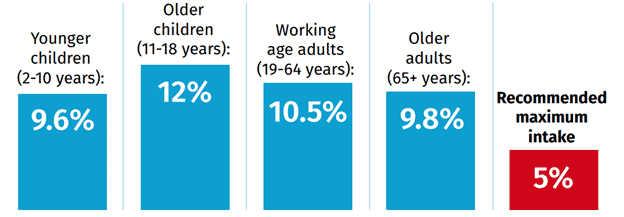
Data shows that over the past ten years, the nation’s nutrient intake stayed consistent, but although the sugar intake decreased overall, consumers eat more than the recommended dosage with about 28% of England adults living with obesity as of 2019. The average weight of adult-age Brits increased with the lack of physical activity and the change in the way adults ate throughout the pandemic – showing an overindulgence in sugar-filled and fatty foods and not enough portions of fibers, fruits, vegetables and fish. But who is responsible for this?
Average consumption of free sugars as a proportion of daily total energy (2020)
Source: Public Health England NDNS: Diet and physical activity – a follow-up study during COVID-19
Average daily saturated fat consumption as a proportion of daily total energy (2020)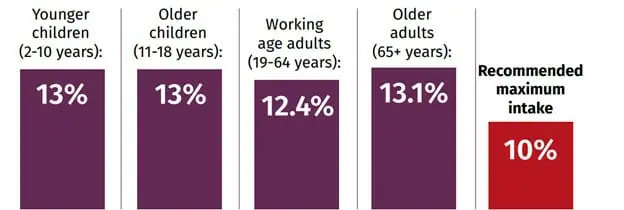
Source: Public Health England NDNS: Diet and physical activity – a follow-up study during COVID-19
According to research from the FSA and FSS’s (The UK Public’s Interests, Needs and Concerns Around Food research), 22% of people in the UK order from takeout and 23% order delivery services at least once a week – mostly coming from young adults or those from higher income households.
The factors found to influence our food choices in recent years according to this data include:
- The price of food: Healthy foods are “priced out” for most people and difficult to keep both wallet and body healthy
- Health concerns: After education over the years, 49% of people interviewed alerted to avoid food with trans fats, palm oil, preservatives, or E numbers
- Eating trends: More people are turning to a “flexitarian” diet to reduce their meat intake
- Ethical concerns: the treatment of animals in the food chain would be a factor of not eating meats; the plastic waste would be another key factor in environmental concern
Impacts from the pandemic on food consumption choices:
- Having healthy eating is tougher to the consumers due to their financial situations
- The pandemic allows more people to cook at home and have healthier options
- Consumers tended to eat more snacks during the lockdown
- More online grocery shopping
Public priorities for the future (research from The FSA and FSS’s The UK Public’s Interests, Needs and Concerns Around Food research) include:
Priority 1: Ensure equitable access to healthy, safe, and affordable foods
- More people intend to purchase healthier foods with an affordable price
Priority 2: Maintain & strengthen food safety and hygiene standards:
- 43% of consumers enforce clearer labelling of food ingredients and allergens is the key priority
Priority 3: Act on additives and processed foods
- People are aware that unhealthy foods contain trans fats, palm oil, preservatives, or E numbers
(Download the full report from the FSA for more priorities, or request demo here for enhancing your business)
Going global:
% of total UK imports sourced from the EU and from other regions, 2017-21
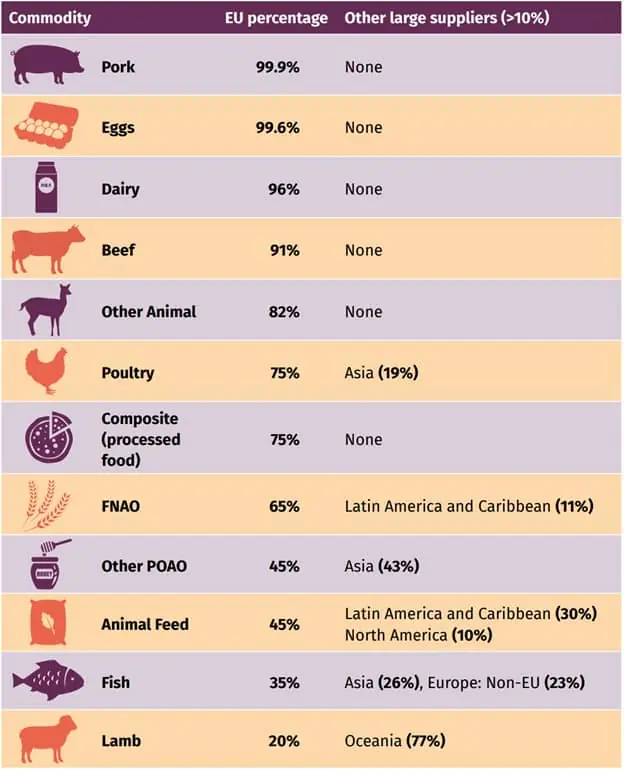
- Around 40 million tons of food are imported from abroad every year; the EU remains by far the biggest supplier, accounting for over 90% of all beef, dairy, eggs, and pork products imported into the UK and nearly two-thirds (65%) of all food and feed not of animal origin
- Despite recent volatility in import patterns, there are no signs of any immediate or wholesale shift in trading flows following the UK’s departure from the EU, though EU imports of fish, lamb and mutton, and pork have all fallen between 2019 and 2021.
- Although there is no evidence that the standards of EU imports have fallen, the FSA and FSS believe the current situation does reduce our ability to prevent foods that do not meet the UK’s high standards from being placed on our market. The lack of import controls means we are not receiving official assurance from the exporting country that imports meet the UK’s high food and feed safety standards; the absence of border checks could also affect how we identify and respond to safety risks in future, with additional resource required by the UK to maintain levels of food safety assurance for these imports
The impact of EU departure on import controls:
- The protocols on Ireland/Northern Ireland took effect on 1 January 2021 and requires Northern Ireland to apply EU import requirements on any products entering the EU regulatory zone from outside the EU
- Not receiving official assurance from the exporting countries that those imports meet the UK’s high food and feed safety standards
To keep rapid alerts available from the latest news from the world, Safefood 360° RISK provides alert system to monitor. Safefood 360° RISK combines both RASFF and World Bank data for the most up to date news and risk alerts and monitor safety alerts worldwide.
Safe and Sound:
- There are 2,363 reported food incidents in the UK in 2021, down from 2019 (2,598) but remains similar number to 2020 (2,261).
- Contamination by harmful micro-organisms was the most frequently reported hazard: 584 cases (browse our technical datasheet to understand how to prevent the harm from the hazards)
- There have been increasing numbers in incidents involving poultry meat in the UK from 2019 – 2021 (83 to 238 cases); especially seen in Salmonella in breaded chicken (download our datasheet about the Salmonella to know the prevention of it)
- Dietetic food incidents have nearly doubled since the previous year (128 cases to 207)
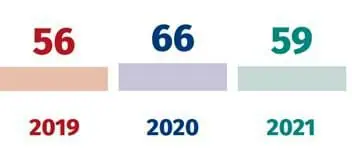
Total number of product recall information notices issued in the UK
Source: FSA/FSS Incident Management Systems
There are 59 cases of recall in the UK in 2021.
Once the food incident has been identified, the food product may have to be withdrawn or recalled, not only costing food businesses money and reputation, but also directly affects the public’s health.
Most of the incidents can be avoided by the good management procedure (HACCP) and by managing the food process with Safety plan management solution. Request a demo to learn more about how Safefood 360° helps you to reduce the chances of food related incidents.
Informing Consumers
The UK’s departure from the EU prompted a series of actions designed to minimise disruption, including new legislation, changes to compositional standards and origin labelling. A new UK Nutrition and Health Claims Committee (UKNHCC) has also been established to provide expert advice and scrutiny on food marketing claims. Existing arrangements remain in Northern Ireland under the terms of the Protocol on Ireland/Northern Ireland.
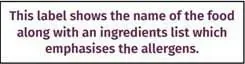
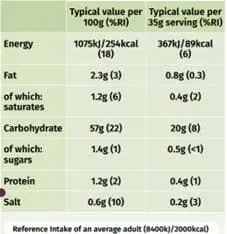
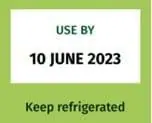
The food labelling must contain the information below:
- Name and description
- Ingredients list
- Nutritional information
- Best before or use by date
- Warnings if the food contains additives such as caffeine
- Places of Origin
Food Labels

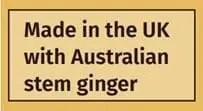
Source: Our Food 2021, FSA report
From a consumer’s point of view, this has had very little noticeable impact to date – the immediate focus has been on maintaining continuity with existing EU laws to minimise any disruption to the supply chain. However, for food business owners, some important foundations for a post-EU approach to food information standards have been put in place:
- Food law changes into British law
- Removing mutual recognition of food composition standards from 1 Oct 2022
- Changes to address and country of origin labelling
What if you have over 500 products in your food business? Our Food Safety Management Solution is designed to improve your business processes within the food industry, allowing you to easily pass audits and maintain compliance with GFSI recognised food safety standards. Browse our Food Safety Management Solution to learn how it helps your business and your supplier chain.
If you are ready to learn more now, request a demo with one of our food safety experts.
Keeping It Clean
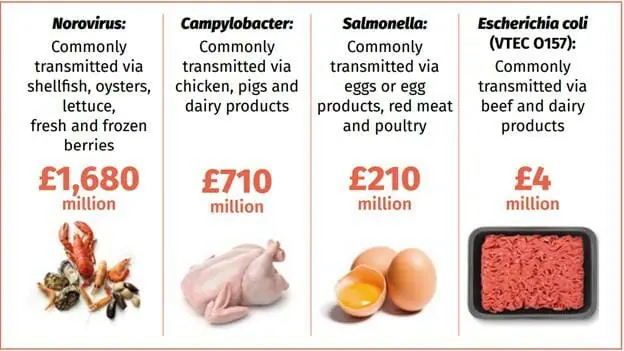
The current level of legal compliance with hygiene standards across food and feed businesses in the UK:
Keeping to monitor the latest legilastion is not easy. Safefood 360° provides an integrated platform for your food safety management and supplier quality management. The software is built by a group of food experts to customise what you really need to secure the assurance and make your aduit become easy. If you have any questions about your current FSMS, SQMS or RISK Assessment systems, submit a demo request for a professional consultation to get your business into next level.


IT Solutions for the Food Industry – Seminar (Dublin, Ireland)
in blogThe aftermath of the horse meat scandal has provided some insight into how both regulatory authorities and the food industry will deal with the issue of species contamination in the future. It appears that the main tool for control will be testing and inspection. Following on from a European wide DNA testing plan endorsed by the EU standing committee, consumers will in the main depend upon testing programmes at both national and business level for assurance on the composition of their food products.
This is not new in the food sector. Despite the adoption of HACCP by the food industry over the last twenty years and its preventative approach to controlling hazards, the industry still depends on testing their food products to confirm the effectiveness of local controls and assure regulatory compliance. Recent events now effectively underpin the necessity for food companies to maintain inspection and testing programmes for food safety, quality and legal criteria. Coupled with traceability requirements and food safety management systems the cost and resource burden increase. Inspection and testing programmes must meet the following criteria:
The key issue here is the management of data through the supply chain in an efficient and repeatable fashion and this is where food companies more and more are investigating the application of IT solutions to help meet their compliance demands.
In response, Safefood 360 are delighted to be partnering with Emydex Technology and Simply Dynamics to present our three IT solutions which can be integrated to meet the most demanding compliance needs of any food business.
The IT Solutions for the Food Industry Seminar will be held on May 28th at Microsoft’s Auditorium Room, Microsoft European Development Centre (Building 2) South Country Business Park, Leopardstown, Co Dublin. It will showcase the three solutions all of which are based on Microsoft cloud technologies.
Emydex specialises in factory floor data capture and traceability reporting systems while Simply Dynamics is a leading provider of ERP business management software to the food sector. Finally we will present the Safefood 360 food safety management solution which covers the specific requirements of global food certification standards and retailer requirements. The presentation will include a worked example of a meat delivery through the process and include deviation management based on a failed DNA test. Integration between the solutions will be highlighted.
For more information and to book your place at this event click the banner below. We look forward to seeing you there.
New Batching Module Launched
in Product UpdatesOne of the biggest impacts of modern food production has been the standardization of the foods we purchase in our local retail store. For many, there is an almost unconscious expectation that a particular food product we buy today tastes exactly the same as it did last week or last month. And when we find a product that we really like then this expectation becomes a demand. We will accept nothing less than a repeatable gastronomic experience.
For the food industry this is a serious business. One of the quickest most effective ways of losing customers is to disappoint them. Unacceptable changes in taste, texture and colour will send your customers looking for a replacement product quicker than you can say ‘process variation’. Moreover a food business which fails to produce a consistent product runs the risk of making an unsafe and illegal one. The intrinsic safety properties of a product often come from its composition and where chemical preservatives are used standardization takes on particular significance.
To manage this critical area most food companies employ a system of batch control. Even where there is a continuous process present there is usually some form of batching involved in the process. Batching control is used to standardize the company’s formulations of recipes. They are often protected and guarded closely by the company to maintain market position and product differentiation. As I say, it is a serious business.
To change focus slightly, my seven year old son recently introduced me to the wonderful and often bizarre world of Spongebog Square Pants. (For those who don’t have a seven year old son, please stay with me). Spongebob, the cartoon character who lives in a pineapple under the sea, works at the local fast-food restaurant whose popularity is based on its delicious Krabby Patty. The secret formula is closely guarded by the Irish owner Mr. Crabs and Spongebob. Evildoers consistently try to steal the secret formula without success. As long as Mr Crabs can keep producing the patty consistently he will stay in business and make lots of money. Even in the world of a seven year old, control of batching, recipes and formulas is serious business.
Inspired more by the compliance needs of customers than Spongebob we are happy to announce the launch of the third module in our new Monitoring Center – Batching. Taking best practice developed over decades in various food safety and technical standards, we have built a solution which allows you do the following:
The module is ideal for meeting the specific requirements found in GFSI standards and retailer technical standards. Paper records can now be eliminated for this operation and real time oversight is available to supervisors, managers and QA staff. Whether you are producing mom’s apple pie, soft drinks, brines, ready meals, cakes or Krabby Patty our new Batching module is a brilliant and sophisticated control tool and as always we want to hear your feedback.
New Monitoring Center Launched
in Product UpdatesOne of the few things we can be certain of in our world is uncertainty. Philosophers have been preoccupied by this phenomenon for centuries and the seemingly relentless drive of nature to introduce change and variation into even the most stable of systems. This is not necessarily a bad thing. Many believe that uncertainty or variation is the key driver behind all developments and improvements in nature. Whether this is true or not, one thing we know for sure is that variation in a manufacturing process if not controlled will lead to product failures, waste and overall poor quality. In food manufacturing it can also lead to food safety issues. The eminent statistician, W. Edwards Deming, dedicated much of his career to studying the nature of variation in production processes and came to many conclusions including “If you can’t describe what you are doing as a process, you don’t know what you’re doing”. This tells us a lot about the nature of food safety management. HACCP is the tool we use to describe ‘what we are doing’. Once we know this we can then get on with the business of monitoring and checking.
Describing and Monitoring are two sides of the same coin. One without the other is meaningless. As Deming states, once we can describe what we are doing we can then measure and monitor our performance. The data from monitoring can be fed back into our understanding to improve it and our feedback loop is complete.
So it is with enormous delight that we announce the launch of our new Monitoring Center. This new center is the product of 12 months of user feedback and the collective experience and expertise of the Safefood 360 team. The advent of this module now provides our users with almost unlimited flexibility when it comes to developing local and site specific monitoring programs. The Monitoring Centre contains two new modules:
Monitoring Module
The monitoring modules is designed to allow food companies set up, plan, record and monitor their specific CCP’s, operational PRP’s, processing parameters and product testing. In fact it is flexible enough to cope with almost any specific monitoring program no matter how simple or complex it may be.
Receiving
The receiving module is designed specifically for the set up and recording of incoming inspection and release of ingredients and materials. Incoming or receiving programs can be designed for simple or multiple deliveries and for bespoke inspection for individual suppliers.
The addition of this new center completes the food safety management loop. What exactly do we get with the new Monitoring Centre? Well we get the facility to:
This represents a very powerful tool for a food company concerned with meeting the requirements of the major global food standards and legislation. More importantly it is accessible without the need for engaging expensive enterprise software vendors, system analysts and consultants.
In the last decade we have seen the emergence of what we now accept to be the standard food safety management system. It comprise three core elements or pillars namely HACCP, Pre-requisite Programs (PRP’s) and Management Systems. HACCP deals with the identification and assessment of food safety hazards; PRP’s cover the fundamentals of safe and hygienic food production; and Management System deal with the high level management processes required for producing safe and legal products. Together they provide an effective tool for the management of food safety in the context of a food plant.
The significant effort that goes into developing these three mandatory elements must however find expression in some form of practical application. This is where monitoring programs come into the food safety equation. Whether we are talking about HACCP, PRP’s or management processes we must ultimately develop a practical method of monitoring the relevant processes, events, inputs and outputs that inform us if we are either in control or more importantly out of control. In many ways we can say that Monitoring is the fourth and most fundamental element of our food safety framework.
As Deming understood, variation is not something to be feared. Once we understand it we can then monitor it and control it. Our new Monitoring module is the tool you require to achieve this. We are certain that you will enjoy using it and we look forward to your feedback as we continue to develop the center to include Batch Control, SPC reporting, Lot Code reporting, Certificate of Analysis generation and many other future features.