Summary of the UK 2021 food report

FSA has released their annual food standards report reviewing food industry trends and changes after the pandemic and the Brexit, here are the impacts on your business:
Since the beginning of COVID-19, in conjunction with the departure from the EU, the UK’s food system was greatly affected in many aspects, including food and feed safety, restaurant compliance and imported food monitoring.
Every country possesses it’s own food safety standards, and has potential food dangers when imported or exported. The summary of the Food Standards Agency (FSA) Report 2021 contains:
The Nation’s Plate
Data shows that over the past ten years, the nation’s nutrient intake stayed consistent, but although the sugar intake decreased overall, consumers eat more than the recommended dosage with about 28% of England adults living with obesity as of 2019. The average weight of adult-age Brits increased with the lack of physical activity and the change in the way adults ate throughout the pandemic – showing an overindulgence in sugar-filled and fatty foods and not enough portions of fibers, fruits, vegetables and fish. But who is responsible for this?
Average consumption of free sugars as a proportion of daily total energy (2020)
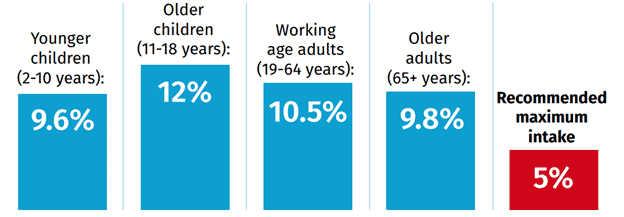
Source: Public Health England NDNS: Diet and physical activity – a follow-up study during COVID-19
Average daily saturated fat consumption as a proportion of daily total energy (2020)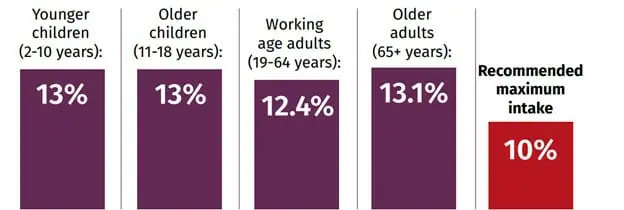
Source: Public Health England NDNS: Diet and physical activity – a follow-up study during COVID-19
According to research from the FSA and FSS’s (The UK Public’s Interests, Needs and Concerns Around Food research), 22% of people in the UK order from takeout and 23% order delivery services at least once a week – mostly coming from young adults or those from higher income households.
The factors found to influence our food choices in recent years according to this data include:
- The price of food: Healthy foods are “priced out” for most people and difficult to keep both wallet and body healthy
- Health concerns: After education over the years, 49% of people interviewed alerted to avoid food with trans fats, palm oil, preservatives, or E numbers
- Eating trends: More people are turning to a “flexitarian” diet to reduce their meat intake
- Ethical concerns: the treatment of animals in the food chain would be a factor of not eating meats; the plastic waste would be another key factor in environmental concern
Impacts from the pandemic on food consumption choices:
- Having healthy eating is tougher to the consumers due to their financial situations
- The pandemic allows more people to cook at home and have healthier options
- Consumers tended to eat more snacks during the lockdown
- More online grocery shopping
Public priorities for the future (research from The FSA and FSS’s The UK Public’s Interests, Needs and Concerns Around Food research) include:
Priority 1: Ensure equitable access to healthy, safe, and affordable foods
- More people intend to purchase healthier foods with an affordable price
Priority 2: Maintain & strengthen food safety and hygiene standards:
- 43% of consumers enforce clearer labelling of food ingredients and allergens is the key priority
Priority 3: Act on additives and processed foods
- People are aware that unhealthy foods contain trans fats, palm oil, preservatives, or E numbers
(Download the full report from the FSA for more priorities, or request demo here for enhancing your business)
Going global:
% of total UK imports sourced from the EU and from other regions, 2017-21
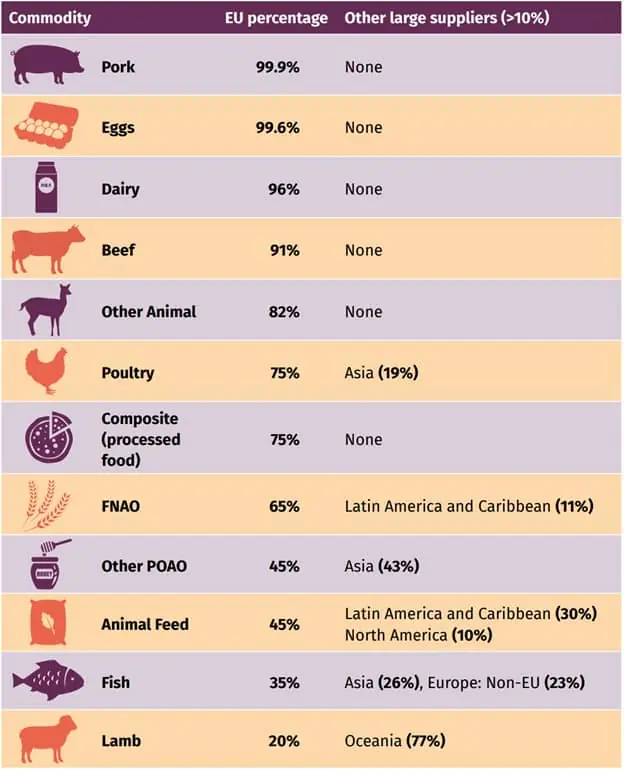
- Around 40 million tons of food are imported from abroad every year; the EU remains by far the biggest supplier, accounting for over 90% of all beef, dairy, eggs, and pork products imported into the UK and nearly two-thirds (65%) of all food and feed not of animal origin
- Despite recent volatility in import patterns, there are no signs of any immediate or wholesale shift in trading flows following the UK’s departure from the EU, though EU imports of fish, lamb and mutton, and pork have all fallen between 2019 and 2021.
- Although there is no evidence that the standards of EU imports have fallen, the FSA and FSS believe the current situation does reduce our ability to prevent foods that do not meet the UK’s high standards from being placed on our market. The lack of import controls means we are not receiving official assurance from the exporting country that imports meet the UK’s high food and feed safety standards; the absence of border checks could also affect how we identify and respond to safety risks in future, with additional resource required by the UK to maintain levels of food safety assurance for these imports
The impact of EU departure on import controls:
- The protocols on Ireland/Northern Ireland took effect on 1 January 2021 and requires Northern Ireland to apply EU import requirements on any products entering the EU regulatory zone from outside the EU
- Not receiving official assurance from the exporting countries that those imports meet the UK’s high food and feed safety standards
To keep rapid alerts available from the latest news from the world, Safefood 360° RISK provides alert system to monitor. Safefood 360° RISK combines both RASFF and World Bank data for the most up to date news and risk alerts and monitor safety alerts worldwide.
Safe and Sound:
- There are 2,363 reported food incidents in the UK in 2021, down from 2019 (2,598) but remains similar number to 2020 (2,261).
- Contamination by harmful micro-organisms was the most frequently reported hazard: 584 cases (browse our technical datasheet to understand how to prevent the harm from the hazards)
- There have been increasing numbers in incidents involving poultry meat in the UK from 2019 – 2021 (83 to 238 cases); especially seen in Salmonella in breaded chicken (download our datasheet about the Salmonella to know the prevention of it)
- Dietetic food incidents have nearly doubled since the previous year (128 cases to 207)
Total number of product recall information notices issued in the UK
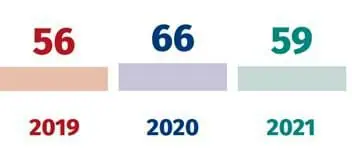
Source: FSA/FSS Incident Management Systems
There are 59 cases of recall in the UK in 2021.
Once the food incident has been identified, the food product may have to be withdrawn or recalled, not only costing food businesses money and reputation, but also directly affects the public’s health.
Most of the incidents can be avoided by the good management procedure (HACCP) and by managing the food process with Safety plan management solution. Request a demo to learn more about how Safefood 360° helps you to reduce the chances of food related incidents.
Informing Consumers
The UK’s departure from the EU prompted a series of actions designed to minimise disruption, including new legislation, changes to compositional standards and origin labelling. A new UK Nutrition and Health Claims Committee (UKNHCC) has also been established to provide expert advice and scrutiny on food marketing claims. Existing arrangements remain in Northern Ireland under the terms of the Protocol on Ireland/Northern Ireland.
The food labelling must contain the information below:
- Name and description
- Ingredients list
- Nutritional information
- Best before or use by date
- Warnings if the food contains additives such as caffeine
- Places of Origin
Food Labels

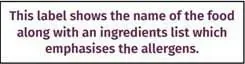
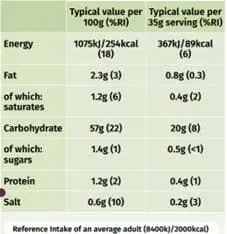
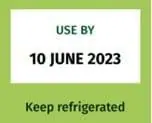
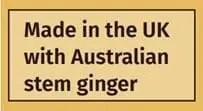
Source: Our Food 2021, FSA report
From a consumer’s point of view, this has had very little noticeable impact to date – the immediate focus has been on maintaining continuity with existing EU laws to minimise any disruption to the supply chain. However, for food business owners, some important foundations for a post-EU approach to food information standards have been put in place:
- Food law changes into British law
- Removing mutual recognition of food composition standards from 1 Oct 2022
- Changes to address and country of origin labelling
What if you have over 500 products in your food business? Our Food Safety Management Solution is designed to improve your business processes within the food industry, allowing you to easily pass audits and maintain compliance with GFSI recognised food safety standards. Browse our Food Safety Management Solution to learn how it helps your business and your supplier chain.
If you are ready to learn more now, request a demo with one of our food safety experts.
Keeping It Clean
The current level of legal compliance with hygiene standards across food and feed businesses in the UK:
Keeping to monitor the latest legilastion is not easy. Safefood 360° provides an integrated platform for your food safety management and supplier quality management. The software is built by a group of food experts to customise what you really need to secure the assurance and make your aduit become easy. If you have any questions about your current FSMS, SQMS or RISK Assessment systems, submit a demo request for a professional consultation to get your business into next level.

IT Solutions for Food Safety Mangement
This is the pre-peer reviewed version of the following article:
George Howlett. IT Solutions for Food Safety Mangement, October 2012, which has been published in the final form at: https://www.foodquality.com/details/article/2785461/IT_Solutions_for_Food_Safety_Mangement.html
———————————————————–
The last decade has seen a major shift in how the safety of our global food supply is managed. High profile food safety incidents have driven a regulatory response, increased consumer consciousness and placed new demands on food business operators.
This shift can be characterised by three key events, the first being the European Union’s (EU) 178 General Principles of Food Safety Regulation. Introduced in 2002, following the BSE and Belgium Dioxin incidents, this regulation represented a radical shake-up in how food businesses in the EU operated. It saw the introduction of the European Food Safety Authority (EFSA), risk assessments as the basis for all food regulatory decisions, the euro-wide rapid alert system and new obligations for food business operators.
The second key event is the emergence of the Global Food Safety Initiative (GFSI) as a core driver in defining what exactly constitutes an effective food safety management system. In May 2000, following a number of food safety incidents, the CEO’s of a group of international retailers identified the need to enhance food safety, ensure consumer protection and to strengthen consumer confidence. The result was the GFSI which sets the requirements for food safety schemes. GFSI benchmarks existing food standards against food safety criteria and looks to ensure these standards have the same core requirements. This facilitates mutual recognition between the requirements of participating standards thus avoiding duplication of audits. GFSI recognized standards include the SQF, BRC, IFS and FSSC 22000. These are rapidly becoming the standards for food certification and many food businesses are required to operate food safety to one of these approved schemes.
Finally, and more recently, is the signing into law in January 2011 of the FDA Food Safety Modernization Act (FSMA). It aims to ensure the US food supply is safe by shifting the focus of federal regulators from responding to contamination to preventing it. It represents a radical development of food safety law in the US and will have wide reaching impacts. The law will bring in changes in how the FDA manages food safety in the areas of prevention, inspection and compliance, food imports and food defense.
But what does all this mean? For Governments it means they are being reactive in order to protect the health of its citizens, and consumers can be assured that their political leaders and major food retailers are on the job. For food businesses, these events have proven to be a powerful motivator to invest in food safety systems to both protect the health of their customers and the value of their brands. However, the practical impact of these events on food businesses can be distilled down even further. In short, they all require food businesses to have in place a food safety plan.
For example, the EU 178 Regulation requires food business operators to identify and regularly review the critical points in their processes and ensure that controls are applied at these points. GFSI standards place HACCP at the core of the internal food safety management system. Moreover, the FSMA will require 165,000 domestic and 254,000 foreign food businesses to have in place a certified food safety plan and herein lays the challenge.
Regulators and retailers require a food safety plan to be implemented. On the face of it this appears to be a reasonable and straight forward requirement. For those on the coal face such as the food technologist, quality manager and consultant the difficulties presented on the ground are clear.
So, what is a food safety plan? Well, at its most basic level it is a written plan defining how a food business ensures the food it produces is both safe and legal. It is developed from a process whereby the management defines how it produces the food, what can go wrong in its production and how the company can detect this and then take action to prevent it reaching the consumer. This is a simple explanation for what in reality is a complex process described in the principles of Hazard Analysis Critical Control Point (HACCP). As any practitioner on the ground will tell you, this is just the beginning. Add to this the need to base your plan on scientific data, develop numerous pre-requisite programme (PRP’s), implement management systems, establish document control, train employees, conduct reviews, improve and revise, and pretty soon the food safety plan develops into a full blown management system requiring significant resources, time, investment and energy. Soon you are introduced to the newly created monster that is your food safety plan.
There is an amusing story about a man who is lost and seeks directions from a stranger he meets on the road. After enquiring about the best route to take to his final destination the stranger calmly informs the man “Well if it was me, I wouldn’t start from here!”
In defining what exactly is a food safety plan we must learn from the simple wisdom of the stranger and start from a different place and a more fundamental definition. A food safety plan is in essence a management process that collects, collates, analyzes and records data. In this sense it is no different from any other management process. This data drives management decisions, demonstrates compliance and is used as a tool to improve. Few would argue against the need for a clear legal and regulatory framework requiring those who produce and sell food products to have in place a robust food safety plan. The reasons are self-evident and supported by well documented events. Nonetheless, it would be hard to find a CEO in a food business that would support the application of significant resources or investment where there exists technology and tools to do the job smarter, quicker and better. After all, haven’t almost all other management processes within food businesses benefited from the introduction of information technology (IT) solutions? Who would dream of operating their financial accounting, human resources or payroll systems without the application of IT? Yet, the question arises; why has food safety management remained the poor relation in the family? Given that the majority of food safety plans are paper based (even in large blue chip food businesses) this is a question that deserves some consideration.
There are a number of reasons, many of which are beyond the scope of this article, however two stand out.
1. Traditional software solutions have not addressed the real needs of the local food safety practitioner. Enterprise software solutions have proven too costly for most food businesses, are sold in modules and are often generic in nature. Even when used the food company still needs to operate certain paper based systems to maintain compliance.
2. The lack of agreement on what exactly constitutes a food safety plan or management system has prevented development of a solution capable of meeting the needs of a global market.
In understanding that a food safety plan centres on data we are taking a step closer to supporting those individuals who will ultimately have to implement the worthy aspirations of regulators and retail buyers.
For example, in developing a HACCP plan the food safety manager must identify and collect data on hazards. This data must then be used to assess risk which again depends on good quality data, much of which is contained on various web based sources. Validating information and data must be generated for critical controls and records maintained to demonstrate compliance against the plan. Controlling potential hazards associated with sourcing suppliers and raw materials is another excellent example. Food businesses must collect significant volumes of data to qualify and monitor suppliers including HACCP plans, specifications, allergen data, questionnaires, audits and certificates. This situation can be replicated across the various other elements of a food safety plan.
Many of the requirements of food safety management are repetitive in nature, involve work flows that are well established and require routine actions. On the other hand, they are living, breathing systems that need to be revised on an on-going basis as new information and events come to light. Here again we see the role information and data play in meeting compliance.
All this lends itself well to the application of IT solutions. The obligations set out in global legislation and commercial standards will undoubtedly require acceleration in the development and use of IT. Two major changes make this a realistic possibility. The first is increasing agreement on what a food safety plan or system is. The GFSI has provided a global standard and framework under which food safety standards can align and this allows for the development of standard IT solutions. The second development is the emergence of web based or cloud technologies as a viable platform upon which these solutions can be delivered. Web technologies change the economics of software and allow enterprise solutions to be delivered and used by both large and small food companies. Software can be quickly updated and users can do work and maintain oversight anywhere in the world with a web enabled device.
When we approached the task of developing our web based software we solicited input from users such as food safety managers, consultants, auditors and retailers and from this defined a number of core principles. The software solution needed to be:
• easy to use, intuitive and meet the needs of the user (food safety manager).
• fully integrated addressing all the requirements of global food safety standards and embody best practice.
• capable of being updated quickly in line with changes in global food standards and regulations.
• designed around the needs of retailers, consultants, external inspectors and certification auditors.
• provide real time data on key food safety events such as recalls, outbreaks and changes in legislation.
• supported by real value adding and time saving enhancements.
• capable of allowing real-time monitoring of multiple production sites within a large corporate structure.
• allow users to access and work on their food safety systems remotely.
• able to generate pertinent reports quickly.
In May of 2011 we launched Safefood 360, a complete online food safety management system designed for food processing and service operations. It contained all the core principles as expressed by our users and was the product of a forensic analysis of global legislation and the GFSI. The solution is fully integrated covering the main pillars of a food safety plan including HACCP, PRP’s, Management and Documents. It has been designed to provide users with a readymade solution addressing food safety requirements and best practice yet is flexible enough to assimilate the specific requirements of local food businesses.
The last decade has indeed been a busy time in food safety management and more changes are on the horizon. Regulation is crucial for maintaining compliance standards in the industry but this is only part of the story. The food industry ultimately is responsible for ensuring its products are both safe and legal and the adoption of new web technologies will play both an increasing and positive role in meeting this challenge.

About the author
George Howlett is the CEO of Safefood 360° and one of Europe’s leading food safety experts. Before establishing Safefood 360° he worked at some of Ireland’s most prominent companies and brings the expertise with him. George also lectures in the MSc for Food Safety Management in the Dublin Institute of Technology.


Glass & Plastic Control: What’s the point? (Part 2)
in blogIn my Nov 26th blog post, I discussed the subject “Glass & Plastic Control – What’s the point?”. In this blog post, I’m going to take a moment to briefly explain how Safefood 360 addresses the GFSI requirements for this subject.
The management and control of foreign body contaminants such as glass and plastic can often feel laborious and repetitive – and it is! But strangely this is the good news. Any system of food safety control that is based on a predefined list of potential hazards which can easily be inspected is as close to ideal as you can get. This is where IT solutions like Safefood 360 show their real strength. They significantly reduce the time required to maintain the system and give more value to the data gathered.
Ultimately, through the use of Safefood 360 you are able to define your audit program, automatically schedule, track, and document activity, generate pertinent corrective actions, and generate reports to demonstrate compliance and/or review results. The laborious is now valuable with a clear return in terms of resources, investment and product safety.
About the author
George Howlett is the CEO of Safefood 360° and one of Europe’s leading food safety experts. Before establishing Safefood 360° he worked at some of Ireland’s most prominent companies and brings the expertise with him. George also lectures in the MSc for Food Safety Management in the Dublin Institute of Technology.
Glass & Plastic Control: What’s the point?
in blogLet me present two examples from my own personal past. The first scenario starts with a government food inspector’s surprise visit a number of years ago. At the time, I did everything that a QA manager was supposed to do. I made sure that I had a pre-determined monthly glass & plastic audit carried out, documented, and saved neatly on an Excel workbook. Whenever an inspection or 3rd party audit took place, I was able to produce my monthly glass & plastic audit to demonstrate that I went through the motions. One morning as I sat working through a mountain of paperwork, the receptionist called to let me know that a badge toting inspector was waiting for me in the lobby.
I asked her to offer her a coffee and I’ll be right over. On my way over to the office, I alerted the floor supervisors that an inspector was on site so they could make sure our ducks were in a row as much as possible. As I meandered to the office in a slow, purposeful manner that would allow the supervisors to clean up without the inspector calling me out for my antics, I gave the production floor an eyeball just to make sure nothing was obviously out of place. While I escorted the inspector through the plant with a feeling of pride that she was seeing a well-oiled machine in action, I took every opportunity to walk ahead of her so I could find any paper towel wads shoved inside of an I-beam because it was closer than the nearest dumpster. I followed the inspector up a flight of stairs where she wanted to walk down the mezzanine and get a better look at the operation from above.
The inspector stopped dead in her tracks, pointed to a few shards of opaque plastic that laid on the mezzanine floor and the looked directly over her head to see a nice hole in the light cover hanging from the ceiling. She was wise to the routine and was nice enough to not make a big deal of it because she noticed the broom nearby and was able to deduce for herself that some good intentioned employee more than likely ran up the stairs to clean up quickly, only to accidentally poke the light cover with the broom handle shortly before we arrived in the area. Now I’ll admit that it was probably my own poor training that led to the employee walking away instead of picking up the pieces…..the point was, for all I knew that light cover could have gotten broken the day before because my “control” amounted to a brisk walkthrough to document an audit and keep things legal.
Moving on to a GFSI audit after an actual control/audit structure was developed based on risk and successfully implemented, sweat no longer beaded up on my forehead worrying that the auditor was going to surprise me. In fact, removing all “non-essential” glass & plastic, protecting all essential (and higher risk) items, and auditing areas at frequencies according to their risk we now had actual control instead of a poorly executed audit. In fact, when we stepped into the production area and took our turns washing our hands, the auditor asked me if the plastic housing on the paper towel dispenser was on my glass register. I affirmed that it was. She asked if I thought that was ok. I told her, and I proudly quote, “Yes, that item was assessed and it was determined to be a low risk item which did not present a hazard to the open product. I even have the crack on the backside of that dispenser documented on the glass breakage register and it will be replaced at the soonest opportunity.” Until then, we will continue to audit it at an increased frequency since it is cracked. The auditor smiled and said “Good answer” and we proceeded with the rest of the audit.The Glass and Plastic program has seen its fair share of attention in the years since GFSI hit the shores of North America. It has caused a lot of head shaking and more than likely an argument or two between the maintenance and QA managers. The increased “control” came by way of improving the programs themselves though, not by adding an additional employee with a clipboard and a continuous roving glass audit. The increased control brings with it exactly what the basis of the GFSI is – safer food!
Let’s take a quick look at BRC Version 6 Clause 4.9.3
The control systems for glass/plastic need to reflect the actual risk of the hazard, and the GFSI has recognized this in their requirements. And it is great to see that a GFSI auditor understands this.
About the author
George Howlett is the CEO of Safefood 360° and one of Europe’s leading food safety experts. Before establishing Safefood 360° he worked at some of Ireland’s most prominent companies and brings the expertise with him. George also lectures in the MSc for Food Safety Management in the Dublin Institute of Technology.