Summary of the UK 2021 food report

FSA has released their annual food standards report reviewing food industry trends and changes after the pandemic and the Brexit, here are the impacts on your business:
Since the beginning of COVID-19, in conjunction with the departure from the EU, the UK’s food system was greatly affected in many aspects, including food and feed safety, restaurant compliance and imported food monitoring.
Every country possesses it’s own food safety standards, and has potential food dangers when imported or exported. The summary of the Food Standards Agency (FSA) Report 2021 contains:
The Nation’s Plate
Data shows that over the past ten years, the nation’s nutrient intake stayed consistent, but although the sugar intake decreased overall, consumers eat more than the recommended dosage with about 28% of England adults living with obesity as of 2019. The average weight of adult-age Brits increased with the lack of physical activity and the change in the way adults ate throughout the pandemic – showing an overindulgence in sugar-filled and fatty foods and not enough portions of fibers, fruits, vegetables and fish. But who is responsible for this?
Average consumption of free sugars as a proportion of daily total energy (2020)
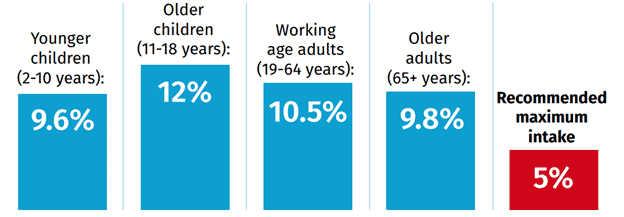
Source: Public Health England NDNS: Diet and physical activity – a follow-up study during COVID-19
Average daily saturated fat consumption as a proportion of daily total energy (2020)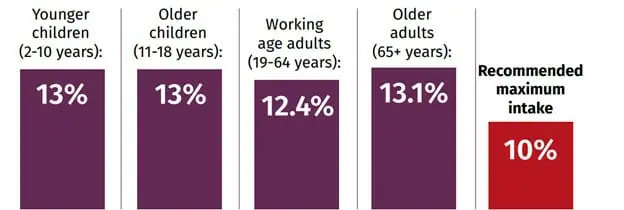
Source: Public Health England NDNS: Diet and physical activity – a follow-up study during COVID-19
According to research from the FSA and FSS’s (The UK Public’s Interests, Needs and Concerns Around Food research), 22% of people in the UK order from takeout and 23% order delivery services at least once a week – mostly coming from young adults or those from higher income households.
The factors found to influence our food choices in recent years according to this data include:
- The price of food: Healthy foods are “priced out” for most people and difficult to keep both wallet and body healthy
- Health concerns: After education over the years, 49% of people interviewed alerted to avoid food with trans fats, palm oil, preservatives, or E numbers
- Eating trends: More people are turning to a “flexitarian” diet to reduce their meat intake
- Ethical concerns: the treatment of animals in the food chain would be a factor of not eating meats; the plastic waste would be another key factor in environmental concern
Impacts from the pandemic on food consumption choices:
- Having healthy eating is tougher to the consumers due to their financial situations
- The pandemic allows more people to cook at home and have healthier options
- Consumers tended to eat more snacks during the lockdown
- More online grocery shopping
Public priorities for the future (research from The FSA and FSS’s The UK Public’s Interests, Needs and Concerns Around Food research) include:
Priority 1: Ensure equitable access to healthy, safe, and affordable foods
- More people intend to purchase healthier foods with an affordable price
Priority 2: Maintain & strengthen food safety and hygiene standards:
- 43% of consumers enforce clearer labelling of food ingredients and allergens is the key priority
Priority 3: Act on additives and processed foods
- People are aware that unhealthy foods contain trans fats, palm oil, preservatives, or E numbers
(Download the full report from the FSA for more priorities, or request demo here for enhancing your business)
Going global:
% of total UK imports sourced from the EU and from other regions, 2017-21
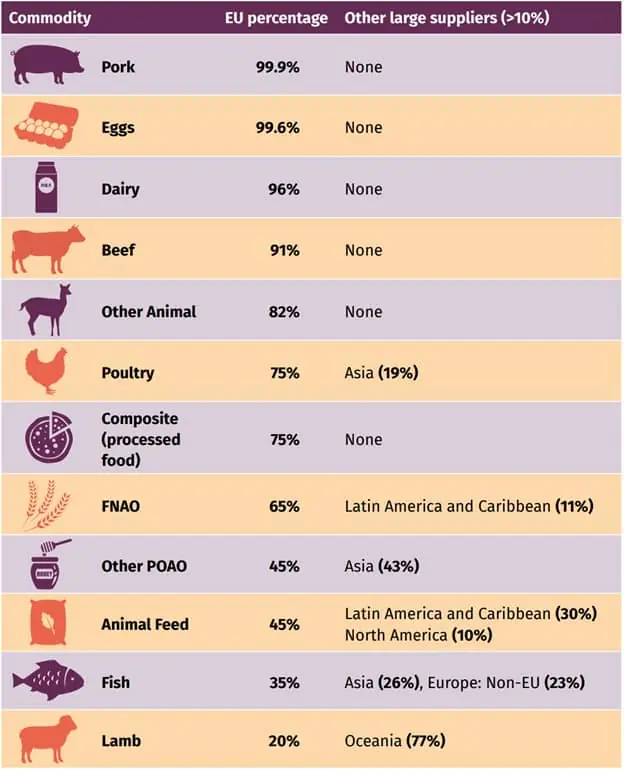
- Around 40 million tons of food are imported from abroad every year; the EU remains by far the biggest supplier, accounting for over 90% of all beef, dairy, eggs, and pork products imported into the UK and nearly two-thirds (65%) of all food and feed not of animal origin
- Despite recent volatility in import patterns, there are no signs of any immediate or wholesale shift in trading flows following the UK’s departure from the EU, though EU imports of fish, lamb and mutton, and pork have all fallen between 2019 and 2021.
- Although there is no evidence that the standards of EU imports have fallen, the FSA and FSS believe the current situation does reduce our ability to prevent foods that do not meet the UK’s high standards from being placed on our market. The lack of import controls means we are not receiving official assurance from the exporting country that imports meet the UK’s high food and feed safety standards; the absence of border checks could also affect how we identify and respond to safety risks in future, with additional resource required by the UK to maintain levels of food safety assurance for these imports
The impact of EU departure on import controls:
- The protocols on Ireland/Northern Ireland took effect on 1 January 2021 and requires Northern Ireland to apply EU import requirements on any products entering the EU regulatory zone from outside the EU
- Not receiving official assurance from the exporting countries that those imports meet the UK’s high food and feed safety standards
To keep rapid alerts available from the latest news from the world, Safefood 360° RISK provides alert system to monitor. Safefood 360° RISK combines both RASFF and World Bank data for the most up to date news and risk alerts and monitor safety alerts worldwide.
Safe and Sound:
- There are 2,363 reported food incidents in the UK in 2021, down from 2019 (2,598) but remains similar number to 2020 (2,261).
- Contamination by harmful micro-organisms was the most frequently reported hazard: 584 cases (browse our technical datasheet to understand how to prevent the harm from the hazards)
- There have been increasing numbers in incidents involving poultry meat in the UK from 2019 – 2021 (83 to 238 cases); especially seen in Salmonella in breaded chicken (download our datasheet about the Salmonella to know the prevention of it)
- Dietetic food incidents have nearly doubled since the previous year (128 cases to 207)
Total number of product recall information notices issued in the UK
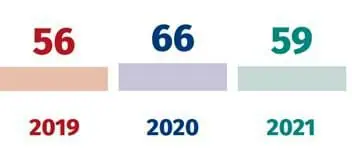
Source: FSA/FSS Incident Management Systems
There are 59 cases of recall in the UK in 2021.
Once the food incident has been identified, the food product may have to be withdrawn or recalled, not only costing food businesses money and reputation, but also directly affects the public’s health.
Most of the incidents can be avoided by the good management procedure (HACCP) and by managing the food process with Safety plan management solution. Request a demo to learn more about how Safefood 360° helps you to reduce the chances of food related incidents.
Informing Consumers
The UK’s departure from the EU prompted a series of actions designed to minimise disruption, including new legislation, changes to compositional standards and origin labelling. A new UK Nutrition and Health Claims Committee (UKNHCC) has also been established to provide expert advice and scrutiny on food marketing claims. Existing arrangements remain in Northern Ireland under the terms of the Protocol on Ireland/Northern Ireland.
The food labelling must contain the information below:
- Name and description
- Ingredients list
- Nutritional information
- Best before or use by date
- Warnings if the food contains additives such as caffeine
- Places of Origin
Food Labels

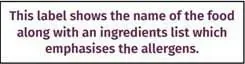
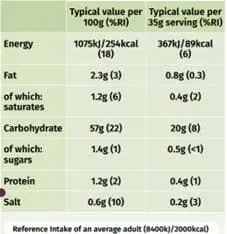
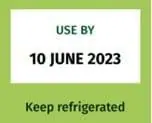
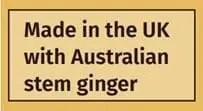
Source: Our Food 2021, FSA report
From a consumer’s point of view, this has had very little noticeable impact to date – the immediate focus has been on maintaining continuity with existing EU laws to minimise any disruption to the supply chain. However, for food business owners, some important foundations for a post-EU approach to food information standards have been put in place:
- Food law changes into British law
- Removing mutual recognition of food composition standards from 1 Oct 2022
- Changes to address and country of origin labelling
What if you have over 500 products in your food business? Our Food Safety Management Solution is designed to improve your business processes within the food industry, allowing you to easily pass audits and maintain compliance with GFSI recognised food safety standards. Browse our Food Safety Management Solution to learn how it helps your business and your supplier chain.
If you are ready to learn more now, request a demo with one of our food safety experts.
Keeping It Clean
The current level of legal compliance with hygiene standards across food and feed businesses in the UK:
Keeping to monitor the latest legilastion is not easy. Safefood 360° provides an integrated platform for your food safety management and supplier quality management. The software is built by a group of food experts to customise what you really need to secure the assurance and make your aduit become easy. If you have any questions about your current FSMS, SQMS or RISK Assessment systems, submit a demo request for a professional consultation to get your business into next level.


Why unannounced audits make sense – and how to deal with them
in blogThe news that ASDA is to commence unannounced audits on its suppliers presents significant challenges for hundreds of food companies. In my previous blog on the subject I explored some of the general impacts on both the auditor and company arising from a system where no previous appointment or notification is provided. Here I will address the specific impacts on the food company and what it can do to properly prepare and maintain standards sufficient to pass an audit comfortably.
Why Unannounced Audits Make Sense
The rationale behind unannounced audits is simple. They provide a more objective picture of the actual standards and level of compliance in a food business. Where audits are announced the company has time to prepare. The physical and hygiene standards of the operation can be raised for the day of the audit, while the food safety management system can be reviewed and brought up to date where gaps are identified. This allows the company to present its business and controls in the best possible light for the day of the audit and can result in fewer non-conformances and a better audit outcome.
In cases where the audit is unannounced, the company is subject to an assessment of what the current standard is today. It is argued that this approach allows the auditor to report on the standards and level of compliance representative of the business day to day and therefore the actual risk of using a particular supplier. If the day-today standard of the company is not sufficient to meet the minimum requirements of the customer or certification scheme then likelihood of more non-conformances and failure increase.
Internal Business Culture
The change in the nature of the audit program goes to the core of how food safety systems are managed in many food businesses. These systems, depending on how they are designed, can be complex and depend heavily on key personnel physically checking and remembering which tasks are due for completion. When you add to this the busy nature and limited resources in a company it is almost evitable that jobs and task get overlooked or omitted. It is these tasks that tend to be unearthed and result in non-conformances in an unannounced audit. The difficulty arises where the non-conformance is significant in nature or where the number of non-conformances is high leading to a failed audit result.
I spent a number of years conducting unannounced audits on food companies on behalf of a food retailer. During this time I observed the same issues reoccurring in many companies as a direct result of the unannounced nature of the site visit.
These may be summarized as follows:
These are just some of the more common issues observed but there were many more. What is interesting about these non-conformances was the fact their root cause usually indicated the failure to complete an action at the required time. They were also issues which could be addressed prior to the completion of an audit in circumstances were it was announced. This is key Point! For companies to prepare for unannounced audits they must address the practical issues resulting task not being completed when required including:
In short, if companies are to prepare properly for unannounced audits they must reflect on the fact that manual and paper based systems make it difficult to stay on top on compliance day to day. Why? Because the unannounced audit reduced the window for compliance to just 1-day as opposed to 6 months or 1 year depending on the frequency of the announced audit program. In other words the company must be compliant each day, every day of the year.
How Technology Can Help You Deal With Unannounced Audits
This is where IT solutions and technology come into play and become a compelling option to meet the new demands of unannounced audits. Safefood 360 contains a number of standard features which allow a food company to culturally and practically adopt a system which meets this one-day compliance window.
Let me explain:
These facilities and features make it practical for a food company to ensure it remains compliant day to day and where tasks are slipping they know about it in real time. Moreover, senior managers can access their system from anywhere in the world at any time. Compliance is maintained even when senior and responsible managers are off site or are responsible for food safety in multiple plants.
New feature “Alerts” will keep you updated
in blog, Product UpdatesFor a food business, if there is any silver lining to be found in a food safety recall of their products (and frankly I struggle to find any) it may be the inevitable change in the culture of the organization. Fresh with the open wounds of public, regulatory and media scrutiny, the food company undertakes a process of managerial and procedural change which will ensure a repeat of the issue(s) leading to the recall is prevented. This reaction usually takes the form of management and operational staff conducting a root and branch review of activities, every batch being forensically analysed and increased frequency in reporting to senior management. In short the organization becomes more alert!
Being alert is essential
This week Safefood 360 announced its Alert Facility enhancement. This new product feature addresses what every senior and food safety manager knows:
Why? Simply put, it is these deviations and omissions which come together over time to create the conditions for failures both internally and in the market place. They can easily go unnoticed in operations where manual and paper systems require humans to physically go through records to find gaps and deviations. Failures in local operations can be festering away for years before they finally explode in a crisis impacting on the larger organization. And it happens even to the biggest and best resourced companies. The resulting increase in organizational alertness is welcome and necessary. But in almost all cases it is a temporary phenomenon. Over time as things settle down this alertness diminishes. It’s not a deliberate thing, it is simply human nature.
Real world consequences
In the last week we have seen a very real example of this. A major global dairy processor recently announced a recall of some of its products in a large market due to potential microbial contamination. The recall has led to internal investigations within the business and the prime minister announcing a special government enquiry – serious stuff. Here we have a perfect example of where an apparent failure to control a basic PRP program in a local processing site has an impact globally, commercially and politically on a major food business. This will undoubtedly make every CEO and senior executive in a major food business uneasy in their chairs. While they are busy strategically developing the business could there be some basic food safety control in some remote plant being overlooked, ready to detonate? The answer is they do not know for sure. And the reason they do not know is because their local manual food safety systems do not highlight or alert senior members of the team to issues as they arise. At best a scheduled audit might highlight concerns but it may be too late. Bottom line – if an activity in a food processing plant is important enough to be specified, scheduled, recorded and reviewed then it is important enough to be alerted in real time when it fails or is neglected.
Stay up-to-date with our new Alerts
This is where Alerts in Safefood 360 comes in. It is a simple, yet tremendously powerful tool which allows each local or group food safety manager to define what events, results, tests, activities, records or workflows trigger alerts specific team members when defined conditions are met. And the solution covers everything in your food safety system. For example, you can within seconds tell Safefood 360 that if a specific high risk sanitizing program is not completed within a specific time after it is due then an alert will be sent to the senior local manager. If the senior local manager does not react within an additional amount of time an alert can be sent to a divisional manager. These alerts can be sent to the individual’s dashboard or by SMS text message and email. Another example, you can tell the system to alert you if a high risk complaint is recorded in any local site. Even better, you can tell the system to alert you if this same high risk complaint is not investigated with 2, 3, or 4 days of receipt. In other words you now have full oversight minute by minute on what is happening in any production unit 24/7 all year around. If a scheduled monitoring inspection or test is overlooked or not completed, again an alert can be sent out. You are in control; your team are in control and where things deviate you will know about it. This is how it should be. We put so much time, energy and resources into developing our control systems only to overlook the most important part. When it goes wrong do we know about it in a timely way? Safefood 360 Alerts feature provides you with the missing link and it is easy to set up, change and control. No expensive consultants required!
Improved company culture
Coming back to human nature. Another positive aspect of having in place an alert system is it changes the culture of the business. Having real time oversight of all local systems is great and for the senior manager essential. However, as your team become aware that all failures or overlooked activities will be alerted and acted upon, the internal culture will change. Over time the need for oversight will decrease for no other reason that you have an oversight system in place. This is how we humans operate and we all work better under a business culture that clearly defines standards. As I say there are few benefits to a product recall except a renewed but diminishing Alert culture. The business objective is to install this as the normal condition. I would like to invite all our existing and potential customers to view a brief demo of this new feature, its benefits and how it can help you and your team.
Unannounced Audits
in blogThe opening line of Walter De La Mare’s The Listeners captures perfectly the feeling I regularly got when as an auditor a number of years ago I was required to conduct unannounced audits on suppliers for a large food retailer. More on this in a moment… but in general, it was an interesting experience. Years before anyone even considered conducting audits on their suppliers without a prior appointment, this retailer had a policy of sending in the auditor at random times, without notice to see the actual conditions under which their products were produced.
The magic of unannounced audits
It was radical, it was disruptive and above all it was effective! As an auditor I learned more about the management of food safety in those years. I quickly understood that audits when unannounced, changed the nature of second and third party audit engagements, changed the direct relationship between parties and undoubtedly changed audit outcomes.
More recently we have seen the BRC provide an option for companies to opt in to unannounced certification audits while a large European food retailer has informed suppliers that all future audits will be unannounced. More and more we are seeing what many of us believe is the unstoppable move towards unannounced audits becoming the norm. The practical impacts of this remain an open question and are worth considering. Before we do this, let’s first take a look at why we are seeing this shift towards unannounced audits.
For years I have listened to the debate on this and the agreements for and against announcing audits in advance. Both camps made compelling arguments and I was often swayed by both. But as is usually the case with issues debated in the realms of principles and opinions – reality comes along and cuts across our passionate beliefs.
Recent food scandals and auditing
For this debate it was undoubtedly the Horse Meat Scandal and other recent international food safety issues. Regardless of our position on unannounced audits the meat scandal in particular highlighted weaknesses in the second and third party audit framework. Some of the plants at the center of the contamination issue were BRC certified and approved directly by large food retailers. Despite auditors regularly inspecting, visiting and certifying these operations the scandal was not detected or prevented.
Now let’s be clear. This is not to say that these plants were intentionally hiding anything or auditors ignoring evidence of fraud – they weren’t but that did not prevent national and international media questioning the effectiveness of certification schemes like BRC or retailer technical approval of suppliers. In short it damaged the credibility and concept of auditing as a food safety and quality management tool. They may have been somewhat separate issues but in the consciousness of the media and public they were closely linked. And for me the reason was simple! It was assumed that audits were an objective assessment of the conditions and controls in place at a specific moment of time i.e. day of the audit.
The public would be surprised to learn that the vast majority of these audits are in fact scheduled and announced in advance. For most people, professional or public, this undermines the validity and objectivity of audits and may produce an audit outcome not necessarily representative of actual conditions. Credibility is undermined. The horse meat scandal raised fundamental questions and the shift towards unannounced audits may represent one of the answers.
Challenges of unannounced audits
What about the impacts on suppliers? Let me take you back to Walter De La Mare’s The Listeners. One of the surprising impacts of unannounced audits was the company’s reaction when I presented at the door. I would estimate that in 25% of cases I was refused entry to the site. It wasn’t long before I felt very much the Lonely Travellerseeking the Phantom Listeners behind the door of the food plant. But such was the reluctance to grant me access to conduct the audit that one could only speculate why a food business would risk its relationship with a significant customer? There were penalties for refusing access. Nonetheless it happened regularly.
My own belief was that it was preferable to suffer the reaction from the retail buyer rather than have the actual conditions of the plant audited on that day. This would be the more cynical of my thoughts but it was undoubtedly the case. In other situations the Quality Manager was not present on site and without prior notification of my arrival that would be a legitimate reason. Another auditor from another retailer may have been on site already conducting an audit or production lines were not operating for maintenance.
Here we can see the practical impacts on both the company and the auditor in attempting to run an audit program without prior arrangements. Other impacts include an almost certain reduction in audit performance and outcome – at least for a period of time while companies adjust to the new regime. This may lead to more suppliers failing and being delisted causing buyers untold headaches in meeting consumer needs. On the upside (at least as far as certification bodies are concerned) more failed audits mean more re-audits which means more revenues. These are just some of the impacts and there are more. The most important question however is the benefit or otherwise of unannounced audits.
A strange kind of logic
I once put the question to a senior retailer technical auditor why were all audits not unannounced? The response was that if a company could not get its act together for an announced audit then it would be clear they were not capable of supplying safe food. This may be true but for me it was a little strange in terms of logic. It assumed a direct relationship between the company’s ability to prepare for a one day visit and the conditions of production the other 364 days of the year. Would an unannounced audit not do the same thing but also show you the actual conditions typical every day? And so the argument went on…
It’s just the right thing to do
My experience as the Lonely Traveller taught me that unannounced audits were infinitely more potent than announced. I know this because I have performed both types of audit on the same food plant and the differences were stark. If the objective of an audit is to determine the level of compliance at a moment in time then we must as a global industry embrace this new move towards unannounced audits. A tool which provides a true reflection of where we are is powerful in maintaining standards and driving improvement – something every food business wants.
The food business has a lot to do in the day and sometimes things are not always perfect. The auditor must also recognize this and not allow unannounced audits to become a hard cynical tool to catch companies out. Common sense and intelligent assessment of risk must underpin the unannounced audit. This will avoid a game of cat and mouse emerging and destroying the positive relationship between parties.
About the author
George Howlett is the CEO of Safefood 360° and one of Europe’s leading food safety experts. Before establishing Safefood 360° he worked at some of Ireland’s most prominent companies and brings the expertise with him. George also lectures in the MSc for Food Safety Management in the Dublin Institute of Technology.