• X
  • Facebook
  • LinkedIn
  • Contact us
  • Login
  • More Information
    • Solutions For:
      • Food Safety Management
      • Supplier Quality Management
      • Enterprise Food Safety
      • Audit Management 360
      • Business Intelligence Dashboards
      • Remote Working and Oversight
    • Technology
      • Software Modules
      • Platform & Data Security
      • Available Languages
      • Standards We Support
  • By Industry
    • Bakeries
    • Seafood Processors
    • Beverage Manufacturers
    • Pet Food & Animal Feed
  • Customer Stories
    • Testimonials
    • UK: Butternut Box
    • EU: Royal FrieslandCampina
    • EU: Hofseth
    • USA: Bluegrass Ingredients
  • Support
    • Technical Support
    • Professional Services
    • Customer Success
    • Education & Training
  • Resources
    • ROI Calculator
    • Webinars
    • Whitepapers
    • Datasheets
      • Physical Hazard Series
      • Chemical Hazard Series
      • Microbiological Hazard Series
      • Food Safety Management Series
    • Presentations
    • Ebooks
    • Tools
  • Blog
  • Company
    • About Safefood 360°
    • Contact Us
  • Demo Request
  • Search
  • Menu Menu
  • More Information
    • Solutions For:
      • Food Safety Management
      • Supplier Quality Management
      • Enterprise Food Safety
      • Audit Management 360
      • Business Intelligence Dashboards
      • Remote Working and Oversight
    • Technology
      • Software Modules
      • Platform & Data Security
      • Available Languages
      • Standards We Support
  • By Industry
    • Bakeries
    • Seafood Processors
    • Beverage Manufacturers
    • Pet Food & Animal Feed
  • Customer Stories
    • Testimonials
    • UK: Butternut Box
    • EU: Royal FrieslandCampina
    • EU: Hofseth
    • USA: Bluegrass Ingredients
  • Support
    • Technical Support
    • Professional Services
    • Customer Success
    • Education & Training
  • Resources
    • ROI Calculator
    • Webinars
    • Whitepapers
    • Datasheets
      • Physical Hazard Series
      • Chemical Hazard Series
      • Microbiological Hazard Series
      • Food Safety Management Series
    • Presentations
    • Ebooks
    • Tools
  • Blog
  • Company
    • About Safefood 360°
    • Contact Us
  • Demo Request

Tag Archive for: BRCGS

BRCGS’ Lessons from the pandemic: Non-Conformities and Training

in blog, Food Safety Industry News, Food Safety Knowledge

This is the final article in a three-part series about the effect the pandemic had on audits.

In our previous articles, we reviewed how audits and the techniques used to run a successful remote or blended audit in the midst of a pandemic were adapted.

What was clear with both of these themes was that the pandemic has had a massive effect on the industry.

In addition to this, we’ve identified that remote and blended audits have contributed to ensuring audits continued despite the pandemic.

Key to this was planning and preparation to ensure the audit went smoothly.

The importance of Information Communication Technology

The role of Information Communication Technology (ICT) cannot be underplayed in this regard.

Technology has a vital role to play in our food supply chains.

Businesses are increasingly turning to digital tools and platforms to support their challenges, using the power of data and automation to problem solve, improve processes and help decision making.

It also increases productivity, enhances transparency, and creates added value from operations right through to the customer experience.

Businesses are increasingly turning to digital tools and… using the power of data automation to problem solve

The pandemic has certainly led to a dramatic increase in the use of some digital tools, and they have been essential to the food industry throughout.

We know that remote auditing would not have been possible without it.

It has been used to demonstrate food safety compliance to auditors and thereby helped maintain certification for hundreds of sites across the globe.

However, it is not without its challenges.

Additional steps such as Confidentiality agreements or Non Disclosure Agreements may need to be signed, and the IAF ID3 and IAF MD4 documents understood and agreed with the Certification Body – they will talk you through this process if you are unsure.

Sites had to learn where their Wi-Fi hot spots and black spots were in advance of the audits – something most technical managers had never done before (a topic we covered in the second part of this series where we focused on remote audit techniques to help prepare for these type of issues).

We did hear about some extremely remote sites having no Wi-Fi at all – making it impossible to conduct a live remote audit.

Sites and auditors used a wide variety of hardware and software during the remote audits to demonstrate compliance and share information.

ICT however does not in any way constitute ‘digitalisation’ which is usually an enterprise-wide project requiring investment and detailed projects.

The pandemic has not necessarily accelerated digitalisation in that respect and may in fact have slowed the process down in certain businesses – we have heard of cases where companies that may have started the rollout of digitalisation have delayed it due to the pandemic taking priority.

On the other hand, companies that already had digital food safety platforms in place had a 3-fold increase in their use by existing customers.

those with digitial food safety platforms in place had a 3-fold increase in their use by existing customers

This is because they realised they could effectively manage their compliance systems remotely using the full set of features their digital platforms already offered.

In other words, the pandemic encouraged digital users to exploit a digitally based compliance solution they already had.

This supports feedback that those using remote technologies to perform internal audits enhanced their control to mitigate food safety risks during the pandemic.

This reiterates the importance of strong internal audit programs, especially when third-party audits were not possible.

Another example of a rapidly evolving digital tool used in the food industry is digital pest monitors.

These integrated pest management tools are a critical component of any food safety program.

Tools – such as rodent monitoring sensors  – can protect operations from pest infestations and the related risks of disease, product loss, and recalls, and they can help ensure your site is audit-ready and compliant with complex regulations such as FSMA and Food Safety Standards.

Training

Digitalisation not only helped with compliance but it also enabled education and enhancement of knowledge.

One of the key lessons we learned is that remote working thrust Virtual Learning into the limelight, which had a huge impact in breaking down the geographical boundaries that have been traditionally associated with classroom learning.

Redesigning Learning

BRCGS made an early commitment to find ways of adapting to support our certificated sites and allow them to continue to develop their teams and to maintain technical competence levels.

This is essential as sites that are more agile, and more people-centric, will be better positioned to bounce back stronger.

By adapting our content and approach we have redeveloped our courses to make sure they are providing an even better online experience.

We reframed the content to improve online engagement and we also adapted our teaching methods, so our learners are getting the best out of the virtual classroom environment.

Redesigning training so that it can be delivered through virtual platforms has been critical to providing brands and specifiers what they seek.

Mobile Microlearning

By developing our mobile-friendly learning option, we’ve made it easy for people to train on the go.

The platform allows learners to target specific skill areas and meet their CPD requirements around their business and personal schedules.

Virtual Events

We have switched from traditional learning conferences to virtual events, which have been extremely successful.

We look forward to continuing to support our global network with virtual, in person and hybrid events throughout the year.

BRCGS Professional

With BRCGS Professional, we have learning programmes which will give you international recognition for the key skills and knowledge essential for product safety management.

And even with the pandemic, we have seen this programme continue to go from strength-to-strength.

In 2020, we welcomed new enrolments from a record-breaking number of new countries around the world and saw the highest number of new graduates from the scheme since it began.

There were 2,900 new enrolments in 2020, 104 professionals graduated, and we had enrolments from 13 new countries.

This demonstrates how virtual training is increasing and the pandemic encouraged people to continue their training during lockdown.

How the pandemic affected Non-Conformities

With all of the techniques described, the digitalisation of audits, and additional training, what was the net result?

Or put another way, did we see a change in non-conformities reported?

This is a tricky question to answer, further complicated by the fact that we are comparing two untypical years.

For most sites, 2019 was their first Issue 8 audit, which was published in August 2018.

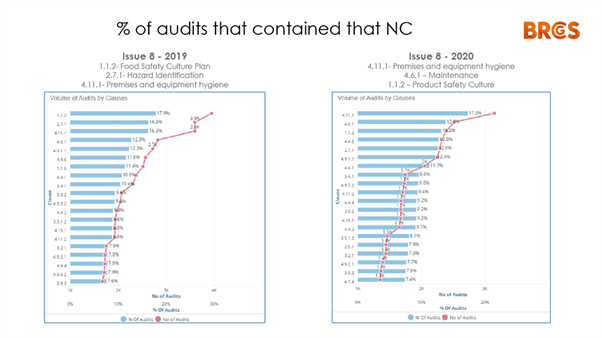
So, their first audits were in 2019, which always affects the patterns of non-conformities as sites tend to get non-conformities against new clauses, due to the fact they need to adapt or understand how to apply them to their facility.BRCGS audits containing non conformances
Then, in the following year, we had the pandemic.

This means we have two consecutive years of potentially ‘untypical’ data to try to trend.

Looking at the left-hand side graph above, clause 1.1.2 in Food Safety Culture was new in Issue 8 and immediately was the top non-conformity.

Food culture is also relatively new for our industry, as well as clause 2.7.1.

The radiological hazards bullet point was new to sites and this caused more non-conformities in positions three and five.

Looking at the right-hand side graph, the top non-conformity was clause 4.11.1 – which has been the top non-conformity for many years.

This shows that in reality that the top non-conformities are not changing that much at the moment.
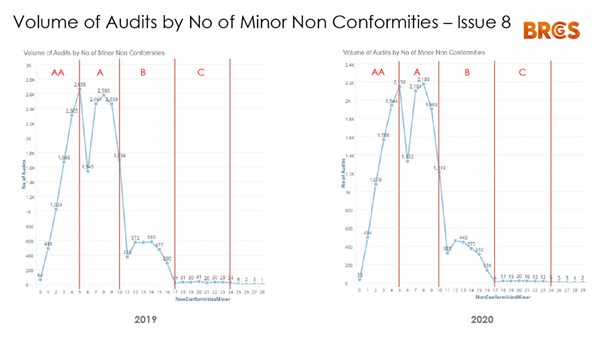
Volume of audits by number of minor non conformities

Another way to analyse this is by total non-conformities by volume of audits.

Looking at the graph above comparing 2019 to 2020, we can see that the overall number of minor non-conformances allocated were slightly down year-on-year but still fairly consistent.

This suggests that despite all the challenges sites are maintaining all the food safety clauses in their sites.

It’s important to note that we do not have all of the data compiled on the remote audits yet nor do we have a statistically significant number of audits completed to make any analysis truly meaningful.

Whilst these trends do point towards a minimal impact, we will need to continue to monitor this dataset as the pandemic continues.

But regardless of what the data shows, to provide assurance to brands and maintain consumer confidence, sites have had to maintain their food safety standards during the pandemic.

Ultimately, this meant they have had to make lots of changes to sites and operations to comply with the new COVID-19 rules.

Therefore, a key learning is that the standard gives them flexibility to change systems in a controlled way to maintain food safety and the associated risks.

This reinforces how the standard is designed to help sites to manage changes in unexpected events such as a pandemic and gives us confidence that the BRCGS standards can achieve their goals in challenging times.

The pandemic has had a big effect but we have responded

In summary, the key lesson we learned from the pandemic was that we had to adapt our ways of working to ensure we continued to provide brand protection for our customers.

Although there are still many learnings to be realised, the remote audit process is working well.

Although there are learnings to be realised, the remote audit process is working well.

It has increased our reliance on virtual training, and with the success of this, it is clear online training is here to stay.

ICT is fundamental to allow the audit function to continue.

Again, test all devices, test access, and communication methods well in advance of the audit.

Perform at least one internal mock audit and then another with the auditor.

This will reduce stress levels on the day.

I hope you have found these articles useful and that they will establish a framework for your very own successful remote or blended audit in the future.

https://safefood360.com/wp-content/uploads/2021/07/BRCGS-Lessons-from-the-Pandemic-Part-3-Non-conformities-and-Training.png 667 1333 https://safefood360.com/wp-content/uploads/Ideagen-Safefood-360-Vertical-Logo.svg 2021-07-22 15:09:552022-11-01 12:15:45BRCGS’ Lessons from the pandemic: Non-Conformities and Training

Lessons from the Pandemic: How BRCGS audits adapted

in blog, Food Safety Knowledge

The COVID-19 pandemic has disrupted our lives and changed so much.

It created new challenges, which were immediate, rapid, unknown and constantly changing.

The level of disruption was unprecedented, as was the response of the remote audit, with platforms such as Safefood 360° being used at an increased scale.

That is because the importance of food safety to manufacturing sites did not change.

Food safety is a number one concern for customers, specifiers, brand owners, and most importantly, for consumers.

Why the remote audit grew in importance

It’s important for us to analyse how the pandemic affected food safety and the lessons learned.

In this three-part series, I am going to outline what BRCGS has observed over the last 12 months of the pandemic and how businesses adapted to ensure they maintained food safety standards, plus their certification.

Whilst there are many lessons to be learnt, I will focus on three main areas across an equal number of articles:

  1. How BRCGS adapted auditing to ensure all sites had options to maintain their certification, including the remote audit
  2. Best practice tips for sites on how to successfully implement a remote audit
  3. The use of ICT and digital platforms to help make the audit process feasible for both sites and auditors

Adapting audits to maintain certification

BRCGS quickly realised that the pandemic was going to seriously effect audits and the obvious risk to consumers was top of mind.

To mitigate this risk, BRCGS quickly adapted its approach for audits to ensure all sites had options to maintain their certification.

As a result, we launched a suite of audit options taking into account the following:

  • GFSI position and their requirements
  • Brand and Retailer feedback
  • Changing and evolving local restrictions
  • Delivery Partner and Auditor availability
  • Maturity and history of site certificationBlog anchor food safety software oversight

Suspension of unannounced audits

A lesson we learned early in the pandemic was that unannounced audits created additional challenges for sites, certification bodies and auditors.

Therefore, BRCGS took the decision to temporarily suspend the unannounced audit programme until at least 31st December, 2021.

Where this is the case, the Certification Body will contact the site to arrange an announced or blended audit.

We will keep this temporary suspension under review and hope to restart unannounced audits as soon as possible.

And once we do relaunch unannounced audits, the industry will be given at least 3 months’ notice.

In addition to this, if a site really needs an unannounced audit, then these can be carried out by exception.

For example, if a customer requirement insists on it or it is as part of a combined audit with another standard, the unannounced audit can go ahead.

Blended Audits for increasing flexibility

The Blended Audit can occur where an onsite visit is possible but applicable only for existing sites.

The audit takes place in two parts:

  • Part 1: remote online assessment of some or all of the documentation
  • Part 2: shorter on-site audit

The main benefit of a blended audit is that it provides the opportunity for a rigorous audit but with a reduction in time spent on site by the auditor.

This has worked well where travel restrictions allowed auditors to visit a region or a country for a few days without having to quarantine.

a blended audit provides the opportunity for a rigorous audit but with a reduction in time spent on site by the auditor

So, if an audit takes 5 days but restrictions allowed an auditor to visit a country for a maximum of 2 days without having to quarantine, that’s where the blended audit option worked well.

The auditor would perform a 3-day remote assessment followed by 2 days on-site.

Due to the introduction of these audits and their impact on sites, auditors and Certification Bodies, they are likely to remain an element of the option for announced audits.

Certificate Extension

Where it is not possible to carry out an onsite audit of an existing certificated site, then this option allowed the certificate to be extended for up to 6 months.

Granting of the extension is based upon a risk assessment and a review between the site and the Certification Body of the controls in place at the site.

Certificate extensions are applicable for existing sites only.

Fully Remote Audit

The remote audit option is not GFSI Benchmarked.

It is available for sites when the certificate extension has expired, and it is still not possible for an audit to take place onsite due to COVID-19 restrictions – or where a site does not need a GFSI recognised certificate.

The remote audit includes a review of internal audit results, a documentation review and video audit of production and storage facilities.

The COVID -19 Additional Module

BRCGS have also published a separate assessment standard which may be used at any time to provide assurance around the management of COVID-19 risks.

It’s done like a remote audit and focuses on areas of the food safety system which are potentially at greater risk as a result of the changes enforced to address COVID-19, for example, changes to supply chains.

Getting the most out of the remote audit – the BRCGS 9 point check list

BRCGS offered plenty of options to allow sites and Certification Bodies to work together and ensure food safety assurances were still in place during the pandemic.

However, in order for those options to be successful – especially the remote audit and blended audit options – sites had to adapt their approach to the audit.

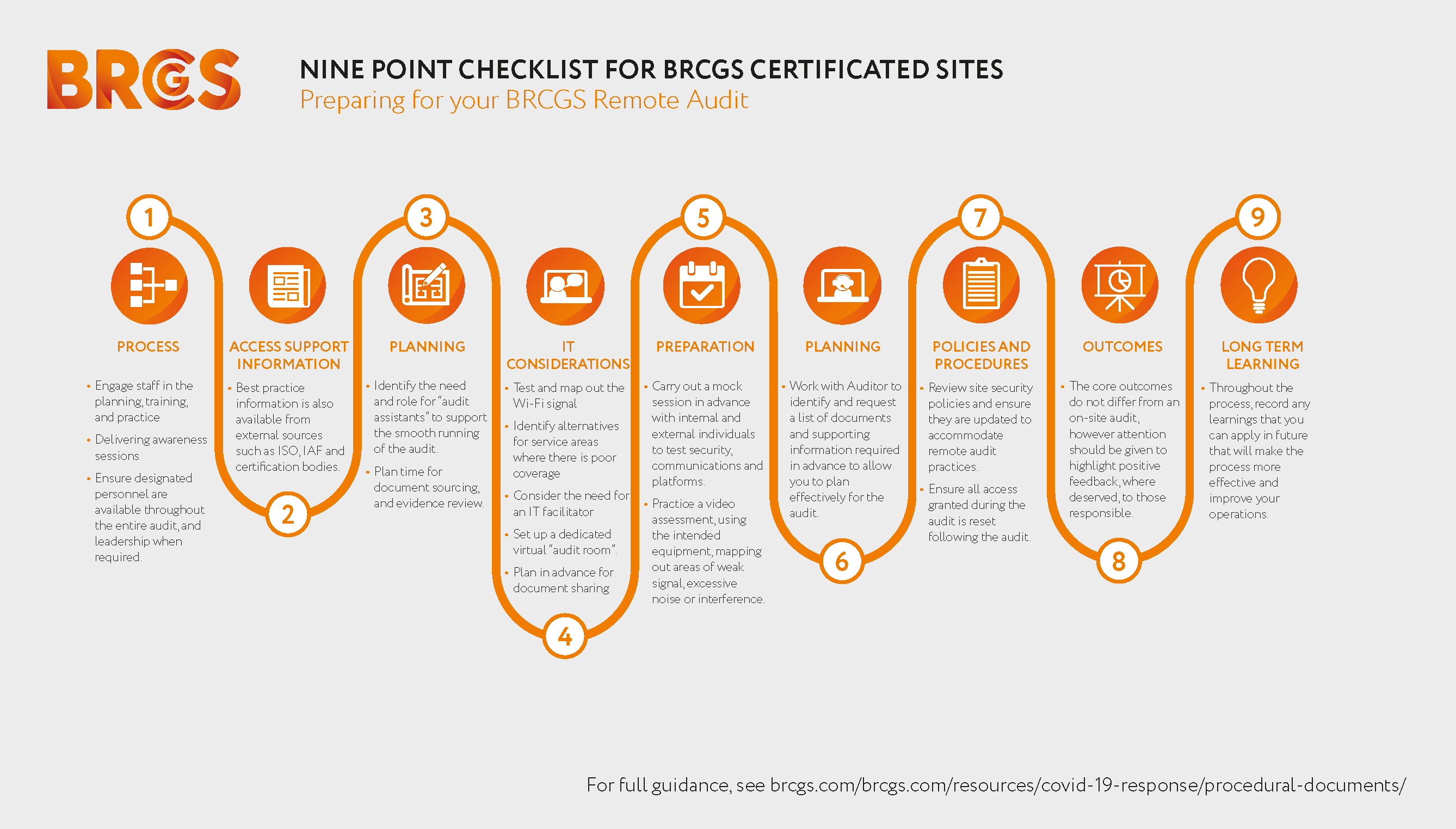
Therefore, we offered a 9-point checklist for sites, Certification Bodies and auditors to help them with or to conduct the most efficient and successful remote audit experience.

remote audit nine point checklist for BRCGS certified sites

Step 1: Process

Engage you staff in the planning of the remote audit, have training and practice in advance.  Ensure designated personnel are available throughout the audit, including leadership.

Step 2: Access Support Information

Make sure best practice information is reviewed for the remote audit from your Certification Bodies, Information Security Officer and International Standards Organisation – there is lots of good information available on ICT and virtual activities and sites are advised to make use of this information, and ensure that relevant staff are therefore prepared.

Step 3 – Planning

This step is absolutely essential – identify the role of audit assistants to support the smooth running of the remote audit.

Who will hold the camera? Who will do the evidence gathering.

Don’t forget to plan in time for screen breaks and natural breaks for both the auditor and the site operators.

We have found the remote audit to be very different and more intense in some ways.

Step 4 – IT Considerations

Test and map out your Wi-Fi signal, have an IT person available throughout, plan in advance how to share documents, and set up a separate remote audit room if possible.

Step 5 – Preparation

Perform a mock test of the equipment, with internal and external people.

Identify weak Wi-Fi signals and test that the lighting on site is good enough for the auditor to be able to see clearly from their remote screen.

It may also be a good idea to send them a map of the site.

Step 6 – Planning

Plan the visit with the auditor in advance of the audit day.

Identify what documents need to be ready or can be sent in advance.

Step 7 – Process and Procedures

It is extremely important to ensure your site security policies and that of the auditor and Certification Body allow for information to be shared or accessed remotely.

This issue came up several times in the feedback from auditors.

Steps  8 & 9 – Outcomes and Learning

Ensure that the outcome of the remote audit is followed through.

Take the learnings from the audit experience and use them next time.

Part two: how to implement a remote audit

The theory and planning is an important part to implementing a remote audit.

It helped us successfully launch and manage sites through remote audits during the pandemic.

However, there is nothing like experience and we are certainly learning a great deal about how to perform a remote audit and the things sites need to consider beforehand.

I will cover this in part two, Remote Auditing Techniques for Sites.

Demo request

This article was written by Angela O’Donovan, Head of Standards Certification Programmes and is part of a series of guest blogs provided by the BRCGS. For more information on the BRCGS, please visit: https://www.brcgs.com/.

https://safefood360.com/wp-content/uploads/2021/05/Lessons-Learned-from-the-Pandemic-How-BRCGS-audits-adapted.png 667 1333 https://safefood360.com/wp-content/uploads/Ideagen-Safefood-360-Vertical-Logo.svg 2021-05-14 17:01:342022-11-01 11:55:12Lessons from the Pandemic: How BRCGS audits adapted
Recent
  • Ideagen Safefood360 logo
    Ideagen launches comprehensive food and beverage compliance...
  • Webinar Cover Image Play
    [Watch] The Economic Benefits to Food Manufacturers Implementing...
  • Radura Symbol 1
    An Introduction to the basics of Food Irradiation
  • Food Fraud 1
    Protecting Our Food: Effectively Tackling Food Fraud
  • Data security 1
    How we ensure trust and security in our software platfo...
  • The Hidden Costs of Food Safety Non Compliance 7 1
    The Costs of Food Safety Non-Compliance: How to Avoid Financial...
  • PDSA blog cover
    Using the Plan Do Study Act Cycle for Better Food Safety...
  • The Answer To Food Safety Digital Transformation Challenges
    The Challenges of Digital Transformation in Food Safety:...
  • SSO
    What is Single Sign On and why do we offer it?  
  • Alcoa Principles What can the food industry learn from life sciences
    Alcoa+ Principles: What can the food industry learn from...
  • Hero image 3
    Introducing Audit Management 360: Better Food Safety Au...
  • Webinar1 SPC 1058 530
    Unlocking the Power of SPC in Food Safety: A Webinar Re...
  • Webinar 2 Mastering Operational and GMP Auditing A Comprehensive Guide to Best Practices 1058 530
    Unveiling the Secrets to Mastery in Operational & GMP...
  • Safefood 360 is top performer on sourceforge in Summer 2023
    Safefood 360°: Top Performer Summer 2023 at SourceForg...
  • RISK Jun 2023 report
    Food Safety Alert Update (June 2023)
  • RISK May 2023 report
    Food Safety Alert Update (May 2023)
  • sf360 Single sign on
    Should I implement single sign-on (SSO) for food safety...
  • How do Chemical Hazards Occur in the food safety process 1
    How do Chemical Hazards occur in the Food Safety Proces...
  • RISK Apr 2023 report
    Food Safety Alert Update (April 2023) by Safefood 360°...
  • How do Physical Hazards Occur in the Food Safety Process 1
    How do Physical Hazards Occur in the Food Safety Proces...
  • The high cost of Cross contamination in the food sector
    The High Cost of Cross-Contamination in the Food Sector
  • RISK Mar 2023 report
    Food Safety Alert Update (March 2023) by Safefood 360°...
  • RISK Feb 2023 report
    Food Safety Alert Update (February 2023) by Safefood 360°...
  • RISK jan 2023 report
    Food Safety Alert Update (January 2023) by Safefood 360°...
  • Novel Food Regulation
    Novel Food Regulation: EFSA versus FDA
  • RISK Dec 2022 report
    Food Safety Alert Update (December 2022) by Safefood 360°...
  • RISK Nov 2022 report
    Food Safety Alert Update (November 2022) by Safefood 360°...
  • Blog post image 13
    Complete Guide to Food Cooking Temperature Control
  • RISK Oct 2022 report
    Food Safety Alert Update (October 2022) by Safefood 360°...
  • Blog post image 8 1
    7 Ways Compliance Management Platforms Improve Operational...
Popular
  • CCP PRP blog
    Understanding the difference between PRP, OPRP & CCP...
  • fsma harpc guidance
    The difference between HACCP and HARPC. A case of the Emperor’s...
  • Auditing
    New checklist available for TS ISO 22002
  • thanks for c360
    Thank you for Connect 360°
Comments
  • Florian BroughWe noticed that your website safefood360.com is getting...5 October 2025 - by Florian Brough
  • Javier CoronesAttract high-quality visitors to your site with our AI-driven...5 October 2025 - by Javier Corones
  • binance sign up bonusThanks for sharing. I read many of your blog posts, cool,...4 October 2025 - by binance sign up bonus
  • Natali ContiWEBINAR: Watch Us Build a Complete AI-Powered Local Marketing...4 October 2025 - by Natali Conti
Tags
food safety food standard and legislation Implementation pandemic Professional Services Report RISK Risk Assessment Tool supply chain webinar

Archives

Frame 16

Safefood 360°, built by a group of food safety experts in 2010, is designed to tackle the real difficulties facing food-related industries by combining Food Safety Management and Supplier Quality Management Solutions with over 35 pre-set modules – creating a fast, secure, and audit-ready working environment.

Follow us
  • Link to Facebook
  • Link to X
  • Link to LinkedIn

Solutions

  • Food Safety Management
  • Supplier Quality Management Software
  • StatusBI Business Intelligence
  • Audit Management 360

Support

  • Technical Support
  • Professional Services
  • Password Reset Instructions
  • Accepting an invitation from Safefood 360°
  • Frequently Asked Questions

Resources

  • Whitepapers
  • Technical Data Sheets
  • Webinars
  • Tools
  • Presentations
  • Privacy Policy
© Copyright – 2026 Ideagen
Scroll to top