• X
  • Facebook
  • LinkedIn
  • Contact us
  • Login
  • More Information
    • Solutions For:
      • Food Safety Management
      • Supplier Quality Management
      • Enterprise Food Safety
      • Audit Management 360
      • Business Intelligence Dashboards
      • Remote Working and Oversight
    • Technology
      • Software Modules
      • Platform & Data Security
      • Available Languages
      • Standards We Support
  • By Industry
    • Bakeries
    • Seafood Processors
    • Beverage Manufacturers
    • Pet Food & Animal Feed
  • Customer Stories
    • Testimonials
    • UK: Butternut Box
    • EU: Royal FrieslandCampina
    • EU: Hofseth
    • USA: Bluegrass Ingredients
  • Support
    • Technical Support
    • Professional Services
    • Customer Success
    • Education & Training
  • Resources
    • ROI Calculator
    • ROI Report
    • Webinars
    • Whitepapers
    • Datasheets
      • Physical Hazard Series
      • Chemical Hazard Series
      • Microbiological Hazard Series
      • Food Safety Management Series
    • Presentations
    • Ebooks
    • Tools
  • Blog
  • Company
    • About Safefood 360°
    • Contact Us
  • Demo Request
  • Search
  • Menu Menu
  • More Information
    • Solutions For:
      • Food Safety Management
      • Supplier Quality Management
      • Enterprise Food Safety
      • Audit Management 360
      • Business Intelligence Dashboards
      • Remote Working and Oversight
    • Technology
      • Software Modules
      • Platform & Data Security
      • Available Languages
      • Standards We Support
  • By Industry
    • Bakeries
    • Seafood Processors
    • Beverage Manufacturers
    • Pet Food & Animal Feed
  • Customer Stories
    • Testimonials
    • UK: Butternut Box
    • EU: Royal FrieslandCampina
    • EU: Hofseth
    • USA: Bluegrass Ingredients
  • Support
    • Technical Support
    • Professional Services
    • Customer Success
    • Education & Training
  • Resources
    • ROI Calculator
    • ROI Report
    • Webinars
    • Whitepapers
    • Datasheets
      • Physical Hazard Series
      • Chemical Hazard Series
      • Microbiological Hazard Series
      • Food Safety Management Series
    • Presentations
    • Ebooks
    • Tools
  • Blog
  • Company
    • About Safefood 360°
    • Contact Us
  • Demo Request

4 tactics for more effective risk communication

When I consult companies who are interested in the Food Safety Planning module (formerly known as HACCP), the most common question they have is, ‘Can your software help us make better risk assessments?’ The simple answer to this is yes, but let’s talk about something different for a change.

There is one completely overlooked element in risk management that is just as important as risk assessing: Risk communication.
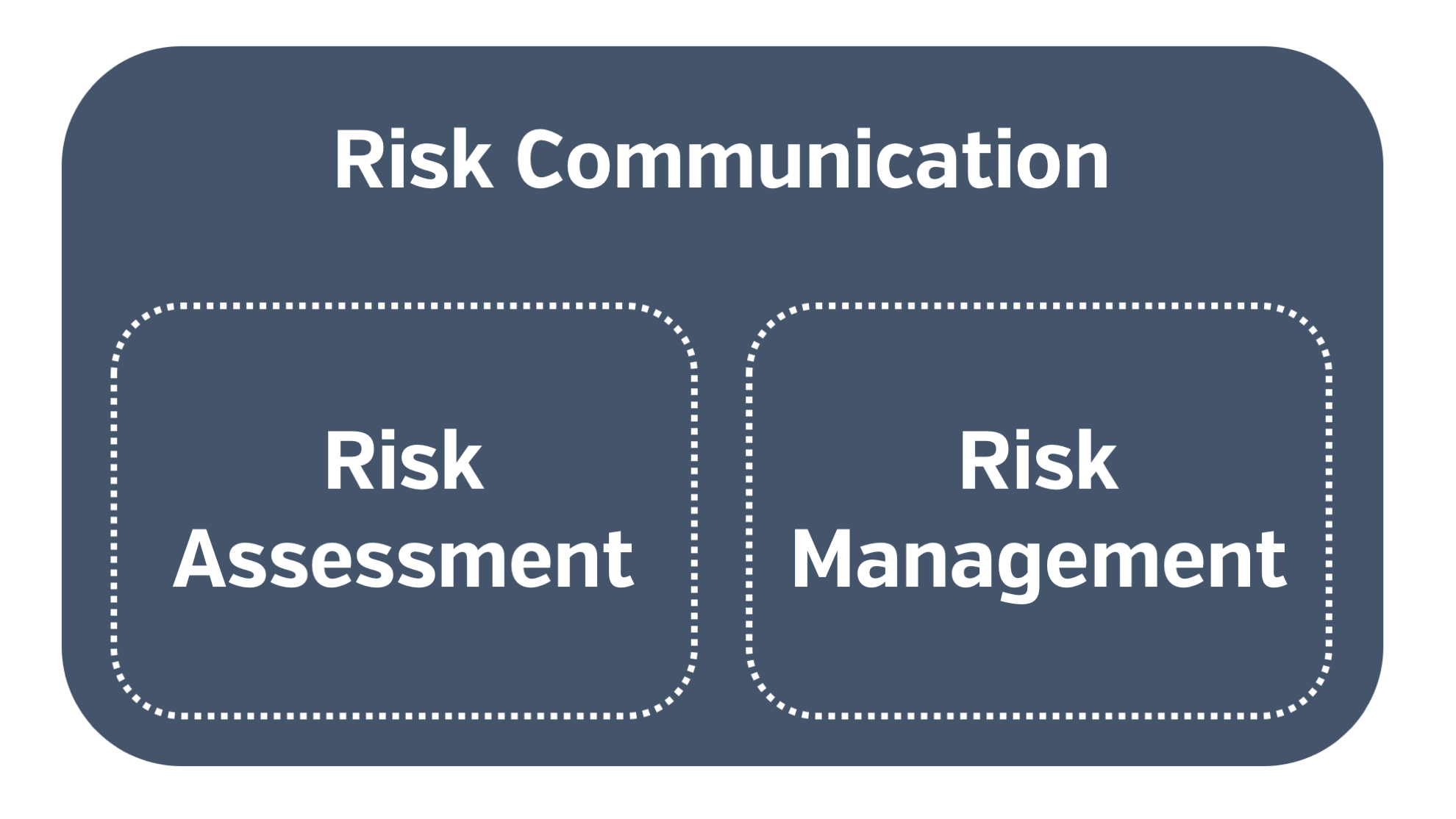
Risk management framework

Indeed, the three elements of a food safety risk management framework are:

  • Risk Assessment: Have all the risks been uncovered and evaluated appropriately?
  • Risk Management: Have the necessary policies been created and enforced to mitigate these risks?
  • Risk Communication: Have relevant stakeholders been made aware of what to do, and are up-to-date on the latest risks?

In the framework of risk management, each of these tenets cannot exist without the other.

What is risk communication?

The Codex Alimentarius definition of risk communication is “The interactive exchange of information and opinions throughout the risk analysis process concerning risk, risk-related factors and risk perceptions, among risk assessors, risk managers, consumers, industry, the academic community and other interested parties, including the explanation of risk assessment findings and the basis of risk management decisions.”

That’s a lot of text, so it’s no wonder if you lost your will to engage in risk communication after reading the above.

But, let’s try to frame this more positively.

It is clear that it doesn’t make sense to invest a lot of time into understanding and mapping risks if the results of this work will be buried in spreadsheets and documents that apparently no-one reads or acts upon.

Blog anchor food safety software oversight

The goal of risk communication is to drive action

Risk communication does not just mean sharing information. The FAO writes that the major function of risk communication “should be to ensure that all information and opinion required for effective risk management is incorporated into the decision-making process.”

Risk communication cannot be successful unless it turns into action which is listened to by those in positions of influence.

As with any form of communication, risk communication cannot be considered successful or relevant unless it turns into action and is genuinely listened to by those in positions of influence.

If risk assessment is the fuel, and risk management is the match, then risk communication is the oxygen without which no fire will ignite.

The problem with risk communication is that it’s not exciting.

Coming up with new risk scenarios and developing policies is creative and feels strategic, while many find the process of how these findings are communicated to be boring and mundane.

But if risk assessment is the fuel, and risk management is the match, then risk communication is the oxygen without which no fire will ignite.

Four tactics that will improve your risk communication today

In this blog, I will share some ideas about how you can improve your risk communication in different ways and achieve:

  • Automated sharing of key information
  • Seamless sourcing of comments and ideas
  • Certainty that all stakeholders have received and reviewed key information
  • The transformation of risk management and risk communication from a one-time exercise into a continuous process

One: Set up alerts for key events

Such key events include:

• New hazard analyses
• New hazards in the database
• New HACCP reviews
• New update reviews

I would set up automatic distribution for all of the above cases.

Alerts are effective for disseminating information, but they do not accomplish the goal of turning information into action. This means that alerts should only be one part of the risk communication toolkit.

Below is a simple example of setting up an automatic notification that will send a PDF copy of new Update Reviews in the system. Why is this useful? Usually, when someone reviews an update, there is a good reason for it: It is connected to a recall, regulatory change, or perhaps even a scientific update  ̶  all things that management should be aware of.
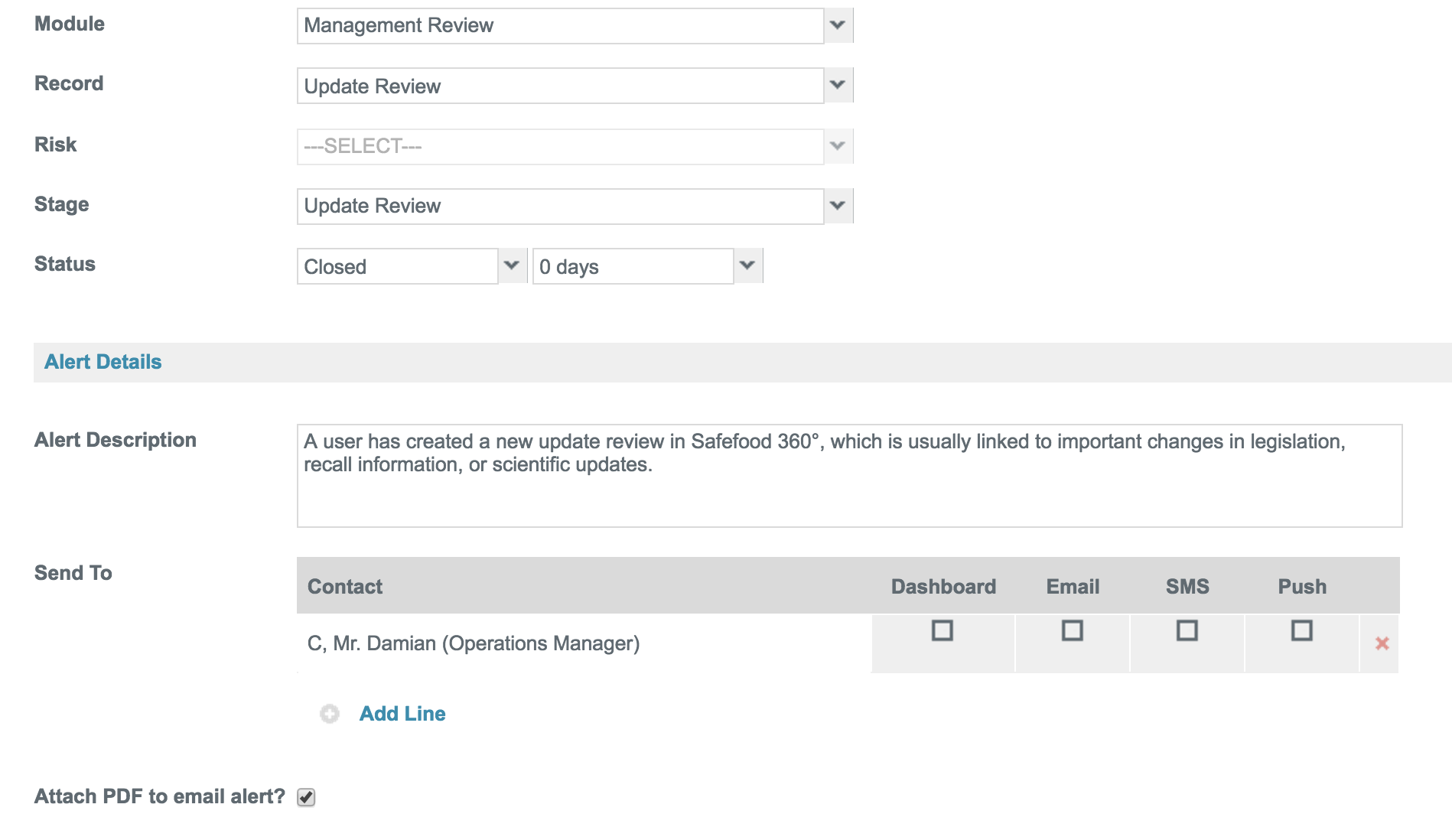
Automatic alert for helping risk communication

Two: Use Discussions for capturing feedback

The fastest way to reach people, regarding new risk assessments or other relevant content, is by using the built-in Discussions module which allows group email threads to be started from any record within the system.

Safefood 360° will keep the followers up-to-date on new entries as the conversation proceeds, and it will store the email conversation in line with the source record.

In the example below, the Discussions feature is used to ask colleagues for further information about a legal change that was featured in the news.
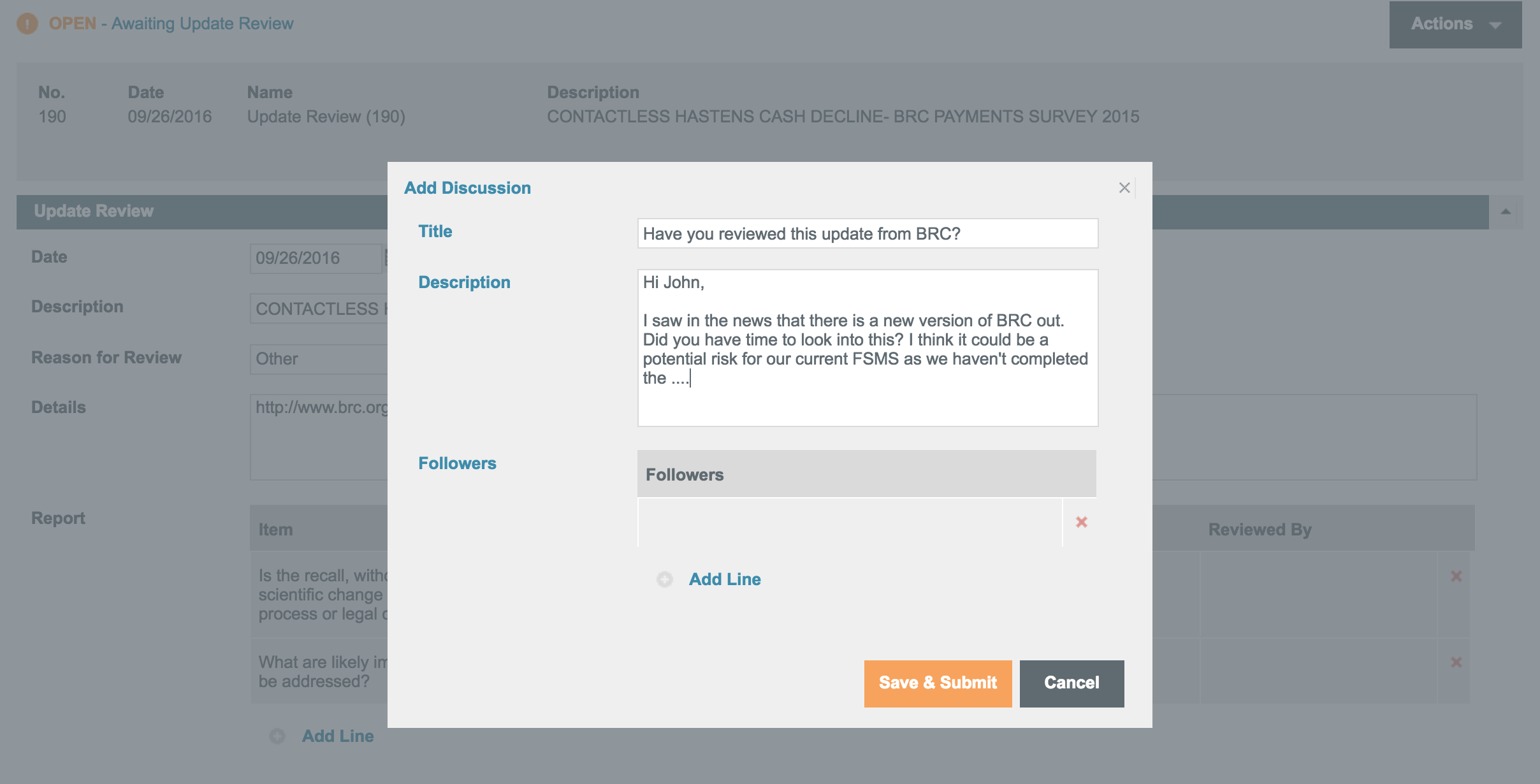
Email discussions as part of risk communication

Three: Ensure people receive and review information by using the Business Process module

One creative use for the Business Process module is to set it up for capturing e-signatures after people have reviewed important content.

It only takes a couple of minutes to set up a basic process in the module, and it can be re-used for any procedure, plan, risk assessment, or management review that you would like to share.

The pictures below show how a two-stage process in the module has been set-up:

  • First stage: The person responsible for risk communication is attaching a document to the process.
  • Second stage: Key people in the company receive an automatic notification from the module to review the document and close the action. There will be an electronic signature captured in the Audit Log showing when the user actually completed the action.
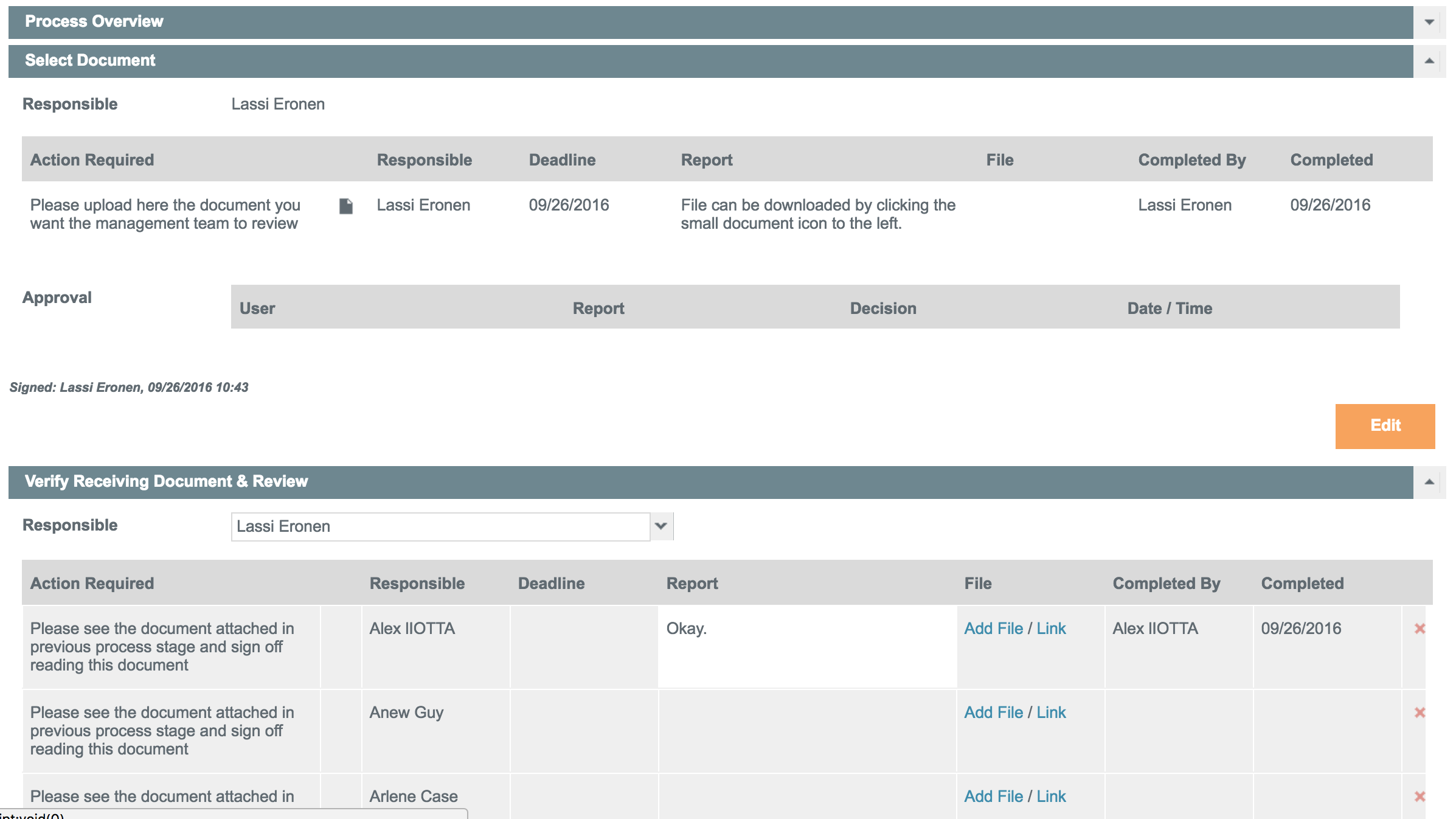
Using business process to verify people have received risk communications

Four: Start an annual risk management meeting

If management is reluctant to start such a meeting, it’s a bad sign and means they don’t really take risk management seriously.

Regular meetings might feel unnecessary at first, but are needed as no organization has the capacity to map out and manage all possible risks as part of a project.

Risk management needs to be an ongoing process where new risks are regularly imagined.

Risk management needs to be an ongoing process where new risks are regularly imagined.

For instance, think about Horsegate. Many companies could not even imagine the possibility of someone manipulating the entire supply chain, from traders to vets and logistics companies, in order to sell horse meat. And yet, they did!

Demo request

This highlights that no matter how thorough the planning, or how outlandish or improbable an event may seem, you should never be complacent. New risks emerge all the time.

For recording these meetings, you could use the Management Review module and have an agenda set up for a recurring management review program.

How do you manage risk communication?

I hope these tactics have been useful. By using the Safefood 360° system more creatively, you can automate and improve many of the parts of risk communication that usually feel difficult and valueless.

How do you manage risk communication in practice? What type of challenges have you had and how did you overcome those challenges?

Recent
  • Ideagen Safefood360 logo
    Ideagen launches comprehensive food and beverage compliance...
  • Webinar Cover Image Play
    [Watch] The Economic Benefits to Food Manufacturers Implementing...
  • Radura Symbol 1
    An Introduction to the basics of Food Irradiation
  • Food Fraud 1
    Protecting Our Food: Effectively Tackling Food Fraud
  • Data security 1
    How we ensure trust and security in our software platfo...
  • The Hidden Costs of Food Safety Non Compliance 7 1
    The Costs of Food Safety Non-Compliance: How to Avoid Financial...
  • PDSA blog cover
    Using the Plan Do Study Act Cycle for Better Food Safety...
  • The Answer To Food Safety Digital Transformation Challenges
    The Challenges of Digital Transformation in Food Safety:...
  • SSO
    What is Single Sign On and why do we offer it?  
  • Alcoa Principles What can the food industry learn from life sciences
    Alcoa+ Principles: What can the food industry learn from...
  • Hero image 3
    Introducing Audit Management 360: Better Food Safety Au...
  • Webinar1 SPC 1058 530
    Unlocking the Power of SPC in Food Safety: A Webinar Re...
  • Webinar 2 Mastering Operational and GMP Auditing A Comprehensive Guide to Best Practices 1058 530
    Unveiling the Secrets to Mastery in Operational & GMP...
  • Safefood 360 is top performer on sourceforge in Summer 2023
    Safefood 360°: Top Performer Summer 2023 at SourceForg...
  • RISK Jun 2023 report
    Food Safety Alert Update (June 2023)
  • RISK May 2023 report
    Food Safety Alert Update (May 2023)
  • sf360 Single sign on
    Should I implement single sign-on (SSO) for food safety...
  • How do Chemical Hazards Occur in the food safety process 1
    How do Chemical Hazards occur in the Food Safety Proces...
  • RISK Apr 2023 report
    Food Safety Alert Update (April 2023) by Safefood 360°...
  • How do Physical Hazards Occur in the Food Safety Process 1
    How do Physical Hazards Occur in the Food Safety Proces...
  • The high cost of Cross contamination in the food sector
    The High Cost of Cross-Contamination in the Food Sector
  • RISK Mar 2023 report
    Food Safety Alert Update (March 2023) by Safefood 360°...
  • RISK Feb 2023 report
    Food Safety Alert Update (February 2023) by Safefood 360°...
  • RISK jan 2023 report
    Food Safety Alert Update (January 2023) by Safefood 360°...
  • Novel Food Regulation
    Novel Food Regulation: EFSA versus FDA
  • RISK Dec 2022 report
    Food Safety Alert Update (December 2022) by Safefood 360°...
  • RISK Nov 2022 report
    Food Safety Alert Update (November 2022) by Safefood 360°...
  • Blog post image 13
    Complete Guide to Food Cooking Temperature Control
  • RISK Oct 2022 report
    Food Safety Alert Update (October 2022) by Safefood 360°...
  • Blog post image 8 1
    7 Ways Compliance Management Platforms Improve Operational...
Popular
  • CCP PRP blog
    Understanding the difference between PRP, OPRP & CCP...
  • fsma harpc guidance
    The difference between HACCP and HARPC. A case of the Emperor’s...
  • Auditing
    New checklist available for TS ISO 22002
  • thanks for c360
    Thank you for Connect 360°
Comments
  • Florian BroughWe noticed that your website safefood360.com is getting...5 October 2025 - by Florian Brough
  • Javier CoronesAttract high-quality visitors to your site with our AI-driven...5 October 2025 - by Javier Corones
  • binance sign up bonusThanks for sharing. I read many of your blog posts, cool,...4 October 2025 - by binance sign up bonus
  • Natali ContiWEBINAR: Watch Us Build a Complete AI-Powered Local Marketing...4 October 2025 - by Natali Conti
Tags
food safety food standard and legislation Implementation pandemic Professional Services Report RISK Risk Assessment Tool supply chain webinar

Archives

Frame 16

Safefood 360°, built by a group of food safety experts in 2010, is designed to tackle the real difficulties facing food-related industries by combining Food Safety Management and Supplier Quality Management Solutions with over 35 pre-set modules – creating a fast, secure, and audit-ready working environment.

Follow us
  • Link to Facebook
  • Link to X
  • Link to LinkedIn

Solutions

  • Food Safety Management
  • Supplier Quality Management Software
  • StatusBI Business Intelligence
  • Audit Management 360

Support

  • Technical Support
  • Professional Services
  • Password Reset Instructions
  • Accepting an invitation from Safefood 360°
  • Frequently Asked Questions

Resources

  • Whitepapers
  • Technical Data Sheets
  • Webinars
  • Tools
  • Presentations
  • Privacy Policy
© Copyright – Safefood 360°
How to integrate Safefood 360° with your ERP in 5 minutesIntegrate Safefood360 with your ERP in 5 minutes 1Passing your first audit Safefood3606 actionable steps to passing your first audit
Scroll to top